A noun is said to be of the feminine gender if it refers to a female person or animal. Recognizing feminine gender nouns is essential for using the correct pronouns (like she, her, hers) and for understanding characters and relationships in both written and spoken English. This guide will clearly define feminine gender nouns, provide a wealth of examples, explain their usage, and offer practice exercises and quizzes, designed for learners from Classes 1 to 10, in line with NCERT and CBSE guidelines.
Feminine Gender: Definition, Examples, Usage, Exercises, PDF Worksheet (Class 1-10 NCERT/CBSE)
Your Comprehensive Guide to Feminine Gender Nouns (Table of Contents)
- What is Feminine Gender? (Definition and Basic Idea)
- Why is Learning Feminine Gender Important?
- Identifying Feminine Gender Nouns
- Examples of Feminine Gender Nouns
- Feminine Gender and Pronouns (She, Her, Hers)
- Ways of Forming Feminine Nouns (from Masculine)
- Feminine Gender in Contrast to Other Genders (Brief Overview)
- Summary Table of Feminine Gender Concepts
- Practice Arena: Feminine Gender Worksheets
- Test Your Knowledge: Quizzes on Feminine Gender Nouns
- Downloadable PDF Worksheet on Feminine Gender
- Common Questions About Feminine Gender Nouns Answered (FAQs)
- Creative Practice: Worksheet Ideas for Feminine Gender Nouns
What is Feminine Gender? (Definition and Basic Idea)
A noun that denotes a female person or animal is said to be of the Feminine Gender. It is one of the four traditional genders assigned to nouns in English grammar (the others being Masculine, Common, and Neuter).
Basic Idea: Feminine gender nouns are words for girls, women, and female animals.
Simple Examples:
- Female Person: girl, woman, queen, mother, princess
- Female Animal: lioness, hen, cow, mare, duck
When we refer to a feminine noun, we typically use feminine pronouns like she, her, and hers.
Why is Learning Feminine Gender Important?
Understanding feminine gender (and other genders) is important for several reasons:
- Correct Pronoun Usage: It enables you to use the correct pronouns (she, her, hers) when referring back to a feminine noun, which is crucial for grammatical accuracy and clarity.
- Example: Sarah is a doctor. She helps many patients. (Using 'she' for the feminine noun 'Sarah')
- Understanding Relationships and Roles: Many feminine gender nouns define family relationships (mother, daughter, sister, aunt) or social roles.
- Reading Comprehension: Identifying the gender of nouns helps in understanding characters, their roles, and relationships within stories and other texts.
- Vocabulary Expansion: Learning feminine gender nouns, especially how they are formed from masculine nouns, enriches your vocabulary.
- Grammatical Foundation: It's a fundamental concept in noun classification that strengthens your overall grasp of English grammar.
Identifying Feminine Gender Nouns
Identifying a feminine gender noun is generally straightforward. Ask yourself: "Does this noun refer specifically to a female being?"
- If the noun names a female person (e.g., aunt, daughter, actress), it is of feminine gender.
- If the noun names a female animal (e.g., tigress, ewe, vixen), it is of feminine gender.
Some nouns are inherently feminine (e.g., woman, girl), while many have a corresponding masculine form (e.g., actor/actress, hero/heroine). This guide will illustrate many such pairs.
Examples of Feminine Gender Nouns
Here are numerous examples of feminine gender nouns, categorized for better understanding:
A. Examples of Feminine Person Nouns (30+)
| Feminine Noun | Example Sentence |
|---|---|
| mother | My mother bakes delicious cakes. |
| sister | His sister is an engineer. |
| daughter | Their daughter won the competition. |
| aunt | My aunt lives in the countryside. |
| niece | She bought a lovely gift for her niece. |
| queen | The queen addressed her subjects. |
| princess | The princess attended the royal ball. |
| empress | The empress ruled a vast empire. |
| actress | The actress gave a stellar performance. |
| heroine | She was the heroine of the adventure story. |
| waitress | The waitress took their orders with a smile. |
| hostess | The hostess made everyone feel welcome. |
| witch | The good witch helped the lost travelers. |
| lady | A kind lady offered her seat. |
| nun | The nun dedicated her life to service. |
| landlady | The landlady maintained the property well. |
| bride | The bride looked radiant in her white dress. |
| headmistress | The headmistress was respected by all students. |
| baroness | The baroness hosted a charity event. |
| countess | The countess wore elegant jewels. |
| shepherdess | The shepherdess watched over her flock. |
| poetess | The poetess (or poet) shared her heartfelt verses. |
| authoress | The authoress (or author) published a new novel. |
| stewardess | The stewardess (or flight attendant) ensured passenger safety. |
| policewoman | A policewoman directed the traffic. |
| saleswoman | The saleswoman assisted the customer. |
| chairwoman | The chairwoman (or chairperson) led the discussion. |
| goddess | Aphrodite was the Greek goddess of love. |
| madam | "Can I help you, madam?" asked the clerk. |
| spinster | In older stories, a spinster was an unmarried woman. |
| governess | The children had a kind governess. |
| prophetess | The prophetess shared her visions. |
| heiress | She was the heiress to a great fortune. |
| mayoress | The mayoress attended the town festival. |
B. Examples of Feminine Animal Nouns (20+)
| Feminine Noun | Example Sentence |
|---|---|
| lioness | The lioness is a skilled hunter. |
| tigress | A tigress fiercely protects her cubs. |
| hen | The hen clucked contentedly. |
| cow | The farmer milked the cow. |
| mare | The beautiful mare galloped across the meadow. |
| duck | The duck led her ducklings to the pond. |
| goose | A large white goose waddled by. |
| ewe | The shepherd sheared the wool from the ewe. |
| doe | A gentle doe grazed in the clearing. |
| she-cat / queen (for breeding female cat) | Our she-cat just had kittens. |
| bitch (female dog) | The bitch was very protective of her puppies. (Note: 'female dog' is often preferred in general conversation). |
| sow | The sow nursed her piglets. |
| peahen | The peahen is the female of the peafowl. |
| vixen (female fox) | The cunning vixen found food for her young. |
| leopardess | A rare leopardess was spotted. |
| she-wolf | The she-wolf howled at the moon. |
| nanny-goat / she-goat | The nanny-goat was very gentle. |
| pen (female swan) | The pen glided gracefully with her cygnets. |
| jenny / jenny-ass (female donkey) | The jenny carried a heavy load. |
| hind (female deer, esp. red deer) | The hind was cautious as she moved through the forest. |
| falcon (female falcon, though 'falcon' is often common) | The female falcon was a swift hunter. |
| queen bee | The queen bee is the mother of the hive. |
| tabby (often refers to female cat, but is a coat pattern) | Our little tabby is very playful. |
Feminine Gender and Pronouns (She, Her, Hers)
When we refer to a noun of feminine gender, we use feminine pronouns to avoid repetition and ensure clarity.
- Subject Pronoun: She (replaces the feminine noun when it is the subject of the verb)
- Example: Mary is a teacher. She is very dedicated.
- Object Pronoun: Her (replaces the feminine noun when it is the object of the verb or preposition)
- Example: I met Mrs. Davis. I gave the flowers to her.
- Possessive Pronoun (determiner): Her (shows possession by a feminine noun)
- Example: That is Lucy's bag. It is her bag.
- Possessive Pronoun (independent): Hers (shows possession and stands alone)
- Example: This pen is not mine, it's hers.
- Reflexive Pronoun: Herself (refers back to a feminine subject)
- Example: The queen prepared the speech herself.
Examples in Sentences:
- The actress was talented. She won many awards. Her performances captivated her audience.
- My sister has a new car. She drives it carefully. The car is hers.
Ways of Forming Feminine Nouns (from Masculine)
While some nouns are inherently feminine, many feminine nouns are formed from their masculine counterparts. Here are the main ways:
1. By Using an Entirely Different Word
For many common relationships and some animals, the masculine and feminine forms are distinct words.
| Masculine | Feminine | Example (Feminine) |
|---|---|---|
| boy | girl | The girl has a red ribbon. |
| man | woman | That woman is a doctor. |
| father | mother | His mother is very kind. |
| brother | sister | My sister plays the guitar. |
| husband | wife | His wife is an architect. |
| king | queen | The queen wore a crown. |
| uncle | aunt | My aunt lives nearby. |
| nephew | niece | His niece is very talented. |
| monk/friar | nun | The nun prayed silently. |
| sir | madam | "Good afternoon, Madam," he greeted. |
| bachelor | spinster (or single woman) | The term spinster is now less common. |
| wizard | witch | The old witch lived in a cottage. |
| gentleman | lady | A lady entered the room gracefully. |
| son | daughter | Their daughter is a good student. |
| horse/stallion | mare | The brown mare ran fast. |
| bull/ox | cow | The cow gives milk. |
| rooster/cock | hen | The hen laid several eggs. |
| dog | bitch (or female dog) | The bitch guarded her puppies. |
| drake | duck | The duck swam with her ducklings. |
| gander | goose | The goose honked at the visitors. |
| ram | ewe | The shepherd tended his ewes. |
| fox | vixen | The clever vixen found food. |
2. By Adding a Suffix (e.g., -ess, -ine, -trix, -a)
A common way to form feminine nouns is by adding a suffix to the masculine form. The most frequent suffix is -ess.
| Masculine | Feminine | Example (Feminine) |
|---|---|---|
| actor | actress | The actress received applause. |
| prince | princess | The princess was kind to all. |
| lion | lioness | A lioness is a powerful hunter. |
| tiger | tigress | The tigress protected her young. |
| waiter | waitress | The waitress brought the menu. |
| host | hostess | The hostess welcomed the guests warmly. |
| heir | heiress | She was the sole heiress. |
| poet | poetess (or poet) | The poetess wrote beautiful poems. |
| author | authoress (or author) | The authoress signed her books. |
| baron | baroness | The Baroness was a philanthropist. |
| count | countess | The Countess lived in a large mansion. |
| shepherd | shepherdess | The shepherdess cared for the sheep. |
| emperor | empress | The empress ruled with wisdom. |
| duke | duchess | The Duchess attended the ceremony. |
| god | goddess | Athena is a Greek goddess. |
| hero | heroine | She was the heroine of the film. |
| testator | testatrix | The testatrix left her property to charity. |
| sultan | sultana | The sultana was known for her generosity. |
Note: Some -ess forms are becoming less common, with the masculine form often used for both genders (e.g., author, poet). However, many -ess forms like 'actress' and 'princess' are still standard.
3. By Changing Part of a Compound Word (or adding a gender-specific word)
For compound nouns, or to specify gender for common nouns, a gender-specific word is often added or a part of the compound is changed.
| Masculine/Common | Feminine | Example (Feminine) |
|---|---|---|
| grandfather | grandmother | My grandmother tells wonderful stories. |
| landlord | landlady | The landlady was very helpful. |
| milkman | milkmaid / milkwoman | The milkmaid delivered fresh milk daily. |
| peacock | peahen | The peahen followed her chicks. |
| manservant | maidservant / womanservant | The maidservant kept the house tidy. |
| salesman | saleswoman / saleslady | The saleswoman explained the product features. |
| he-goat / billy-goat | she-goat / nanny-goat | The nanny-goat grazed peacefully. |
| chairman | chairwoman / chairperson | The chairwoman addressed the board. |
| policeman | policewoman | A policewoman helped direct traffic. |
| boyfriend | girlfriend | His girlfriend is very supportive. |
| schoolboy | schoolgirl | The schoolgirl carried a heavy bag. |
Feminine Gender in Contrast to Other Genders (Brief Overview)
To better understand feminine gender, it's helpful to see it in contrast to the other genders:
- Masculine Gender: Refers to male persons or animals (e.g., man, boy, king, lion). Pronouns: he, him, his.
- Common Gender: Refers to nouns that can be either male or female (e.g., student, teacher, doctor, parent). Pronouns: he/she, they (singular).
- Neuter Gender: Refers to non-living things, objects, or ideas that have no biological sex (e.g., book, table, happiness). Pronoun: it, its.
This guide focuses on Feminine Gender, often in relation to its Masculine counterpart.
Summary Table of Feminine Gender Concepts
| Concept | Description | Key Points / Examples |
|---|---|---|
| Feminine Gender Noun | Names a female person or animal. | woman, girl, queen, lioness, actress, mother |
| Identification | Refers specifically to a female entity. | "a princess" (one female royal) |
| Pronouns Used | Typically she, her, hers, herself. | The girl loves her doll. She plays with it. |
| Formation | Often formed from masculine by different word, suffix (-ess), or compound change. | Masculine: actor; Feminine: actress |
| Contrast | Different from Masculine (male), Common (either), and Neuter (no sex). | Feminine: aunt; Masculine: uncle |
Practice Arena: Feminine Gender Worksheets
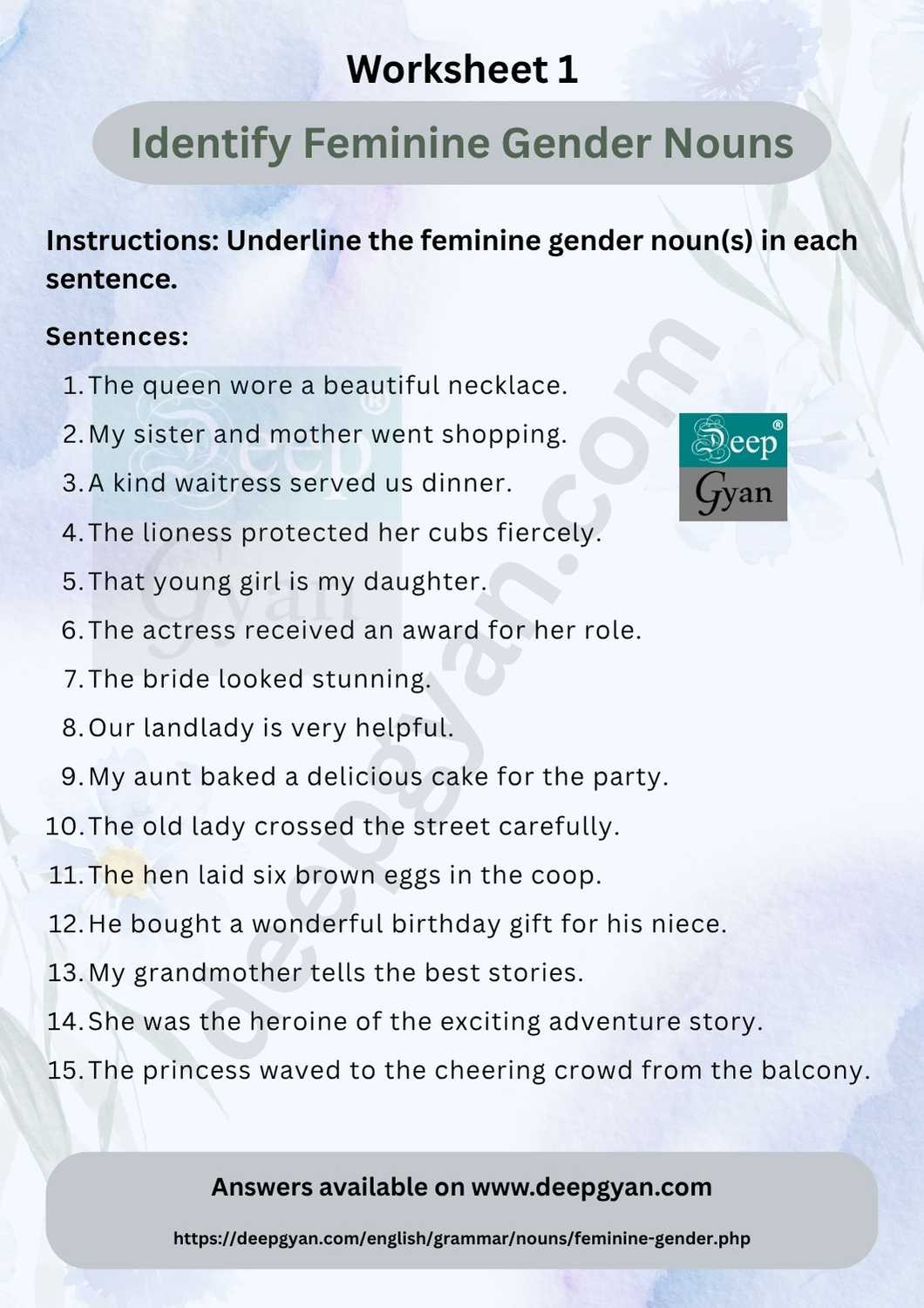
Exercise 1: Identify Feminine Gender Nouns
Underline the feminine gender noun(s) in each sentence.
- The queen wore a beautiful necklace.
- My sister and mother went shopping.
- A kind waitress served us dinner.
- The lioness protected her cubs fiercely.
- That young girl is my daughter.
- The actress received an award for her role.
- The bride looked stunning.
- Our landlady is very helpful.
- My aunt baked a delicious cake for the party.
- The old lady crossed the street carefully.
- The hen laid six brown eggs in the coop.
- He bought a wonderful birthday gift for his niece.
- My grandmother tells the best stories.
- She was the heroine of the exciting adventure story.
- The princess waved to the cheering crowd from the balcony.
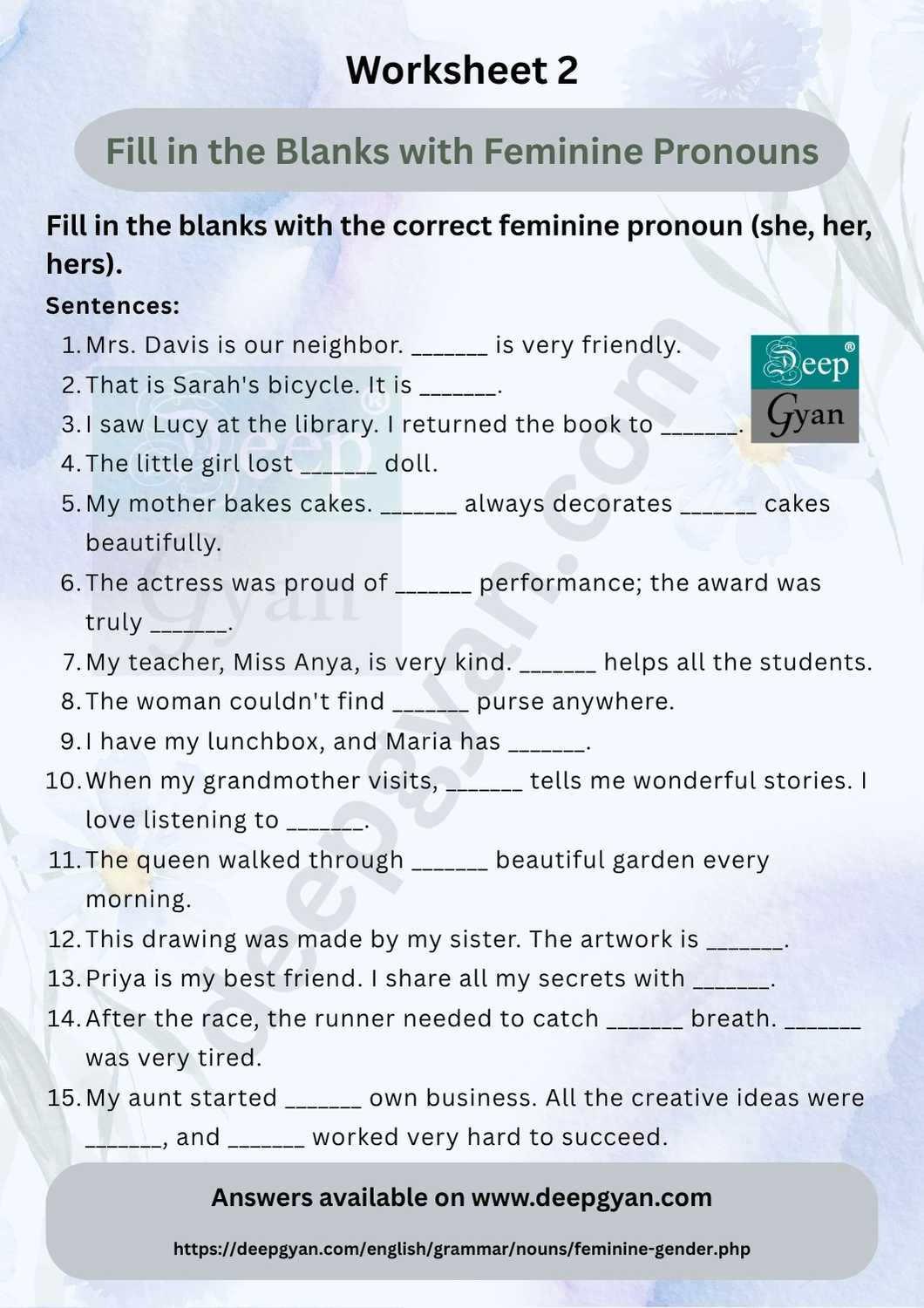
Exercise 2: Fill in the Blanks with Feminine Pronouns
Fill in the blanks with the correct feminine pronoun (she, her, hers).
- Mrs. Davis is our neighbor. _______ is very friendly.
- That is Sarah's bicycle. It is _______.
- I saw Lucy at the library. I returned the book to _______.
- The little girl lost _______ doll.
- My mother bakes cakes. _______ always decorates _______ cakes beautifully.
- The actress was proud of _______ performance; the award was truly _______.
- My teacher, Miss Anya, is very kind. _______ helps all the students.
- The woman couldn't find _______ purse anywhere.
- I have my lunchbox, and Maria has _______.
- When my grandmother visits, _______ tells me wonderful stories. I love listening to _______.
- The queen walked through _______ beautiful garden every morning.
- This drawing was made by my sister. The artwork is _______.
- Priya is my best friend. I share all my secrets with _______.
- After the race, the runner needed to catch _______ breath. _______ was very tired.
- My aunt started _______ own business. All the creative ideas were _______, and _______ worked very hard to succeed.
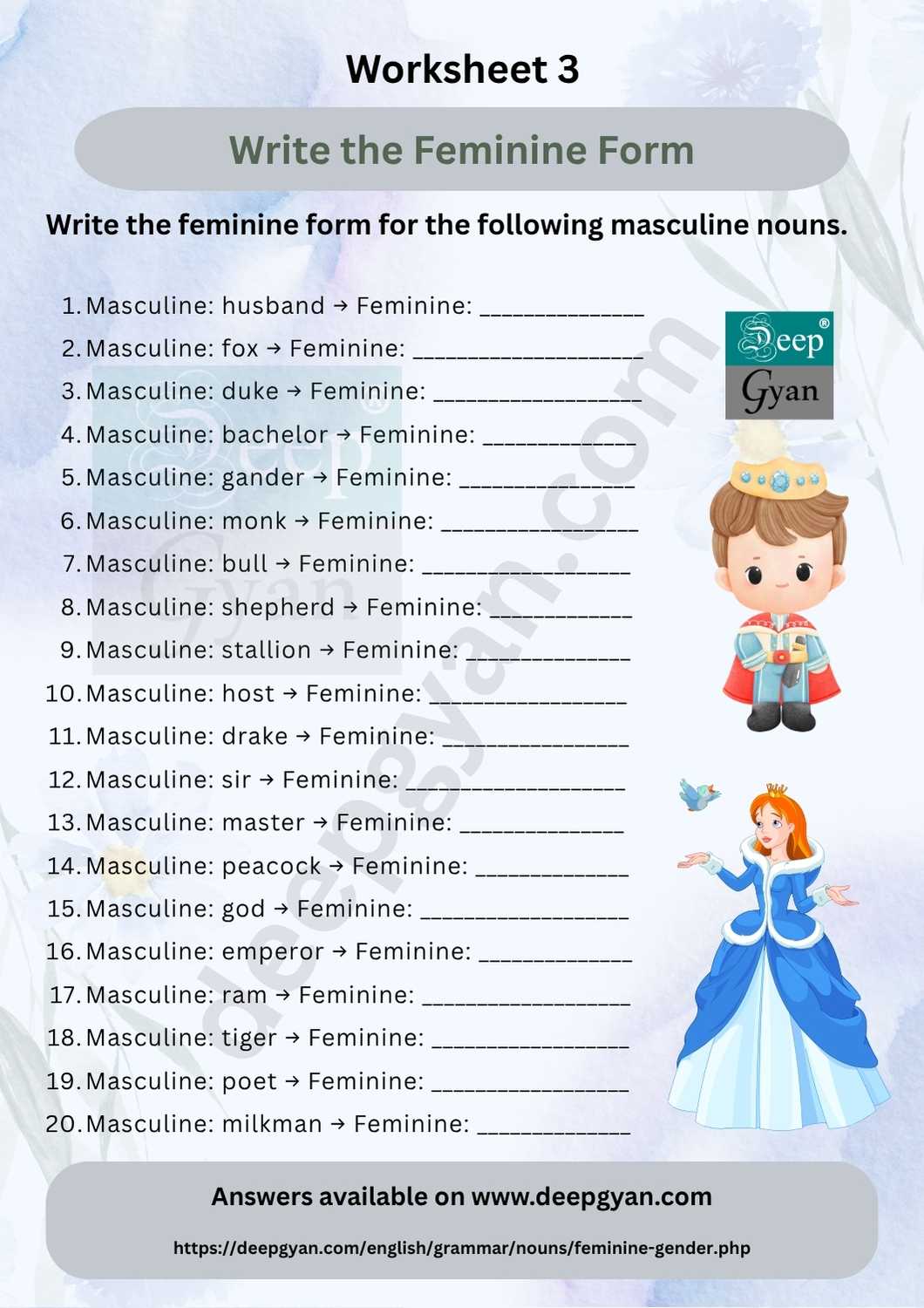
Exercise 3: Write the Feminine Form
Write the feminine form for the following masculine nouns.
- Masculine: husband → Feminine: _______
- Masculine: fox → Feminine: _______
- Masculine: duke → Feminine: _______
- Masculine: bachelor → Feminine: _______
- Masculine: gander → Feminine: _______
- Masculine: monk → Feminine: _______
- Masculine: bull → Feminine: _______
- Masculine: shepherd → Feminine: _______
- Masculine: stallion → Feminine: _______
- Masculine: host → Feminine: _______
- Masculine: drake → Feminine: _______
- Masculine: sir → Feminine: _______
- Masculine: master → Feminine: _______
- Masculine: peacock → Feminine: _______
- Masculine: god → Feminine: _______
Test Your Knowledge: Quizzes on Feminine Gender Nouns
Quiz 1: Multiple Choice - Identifying Feminine Gender
Choose the word that is a feminine gender noun.
- Which is a feminine gender noun?
(a) king (b) book (c) queen (d) teacher - Which noun refers to a female animal?
(a) ram (b) vixen (c) gander (d) drone - "My sister is a pilot. ___ flies planes." The correct pronoun is:
(a) He (b) It (c) She (d) They - The word 'niece' is:
(a) Feminine Gender (b) Masculine Gender (c) Common Gender (d) Neuter Gender - The feminine of 'monk' is:
(a) monkess (b) monka (c) nun (d) priestess - The feminine form of 'waiter' is:
(a) lady waiter (b) waiteress (c) she-waiter (d) waitress - Which of the following is a title for a female noble?
(a) duke (b) emperor (c) duchess (d) baron - "The girl is looking for ___ shoes." The correct word is:
(a) his (b) hers (c) her (d) its - A female horse is called a:
(a) stallion (b) mare (c) ewe (d) colt - If a man who owns a property for rent is a 'landlord', a woman who does the same is a:
(a) land-woman (b) landlordess (c) landlady (d) lady-lord
Quiz 2: True or False - Feminine Gender Facts
Determine if the following statements are True or False.
- A feminine gender noun always refers to a non-living thing. (True / False)
- 'Hers' is a feminine possessive pronoun. (True / False)
- The noun 'waiter' is feminine gender. (True / False)
- 'Stallion' is a feminine gender noun for a horse. (True / False)
- 'Girl' is an example of a feminine gender noun. (True / False)
- All feminine nouns are formed by adding '-ess' to the masculine form. (True / False)
- The masculine of 'goose' is 'gander'. (True / False)
- The pronoun 'she' is used for masculine gender nouns. (True / False)
- The feminine of 'actor' is 'actress'. (True / False)
- The noun 'doctor' is always a feminine gender noun. (True / False)
- 'Vixen' is the feminine form of 'fox'. (True / False)
- In poetry, the Moon is sometimes given a feminine gender. (True / False)
- The feminine form of 'duke' is 'dukess'. (True / False)
- The word 'aunt' is a feminine gender noun. (True / False)
- In the sentence "That is her book," the word 'her' is a subject pronoun. (True / False)
Downloadable PDF Worksheet on Feminine Gender
For comprehensive practice on identifying and forming nouns, download our specially designed PDF worksheet. It includes a variety of exercises, including matching, fill-in-the-blanks, and conversion tasks, suitable for Class 1, Class 2, Class 3, Class 4, Class 5, Class 6, Class 7 and Class 8. An answer link is included.
Download Worksheets on Noun (Mixed Exercises)
Download Worksheets on Animals and Birds Gender
Download Worksheets on Noun Gender
Download Worksheets on Feminine Gender
Download Worksheets on Masculine Gender
Download PDF of List of Masculine & Feminine Gender
Download PDF of Change the Gender in Sentences
Download PDF of Masculine and Feminine Genders Worksheets - Fill in the Blanks
Download PDF of Masculine and Feminine Genders Worksheets - Match the Pairs
Download PDF of Masculine and Feminine Genders Worksheets - Write the Opposite Genders
Common Questions About Feminine Gender Nouns Answered (FAQs)
Q1: What is the main characteristic of a feminine gender noun?
The main characteristic is that it refers specifically to a female person or a female animal. Examples include woman, girl, mother, queen, lioness, hen.
Q2: Which pronouns are used for feminine gender nouns?
The primary pronouns used for feminine gender nouns are: she (subject), her (object and possessive determiner), and hers (possessive independent). The reflexive pronoun is herself.
Q3: Do all feminine nouns have a corresponding masculine noun?
Most do, especially for people and common animals (e.g., queen/king, actress/actor, cow/bull). However, some terms might be more specific or common for one gender. For instance, while 'nurse' is common gender, historically it might have been associated more with females, but there isn't a distinct "masculine nurse" word.
Q4: Why are some feminine forms like 'poetess' or 'authoress' used less now?
There's a trend towards using common gender terms for professions to be more inclusive. So, 'poet' and 'author' are now commonly used for both men and women, making 'poetess' and 'authoress' sound somewhat dated or unnecessary to some. However, other forms like 'actress' or 'princess' are still widely used.
Q5: Can inanimate objects like a ship be feminine?
Typically, inanimate objects are Neuter Gender (it/its). However, in a practice called personification, especially in literature or traditional contexts, some objects like ships, cars, or even countries are referred to with feminine pronouns ('she'/'her'). This is more of a stylistic choice than a strict grammatical rule for these objects.
Creative Practice: Worksheet Ideas for Feminine Gender Nouns
Adapt these ideas for different class levels:
- "She is a..." (Basic): Show pictures of female persons/animals (e.g., a girl, a lioness) and have students complete the sentence "She is a _______." or "This is a _______."
- Feminine Match (Basic/Intermediate): Provide masculine nouns and ask students to match them with their feminine counterparts from a list.
- Pronoun Practice (Intermediate): Write sentences with a feminine noun as the subject, and have students fill in the blanks with the correct feminine pronoun (she, her, hers).
- Feminine Noun Story (All Levels): Students write a short story featuring at least five different feminine gender nouns and use appropriate pronouns.
- "Who Am I?" - Feminine Edition (Intermediate): Write descriptions of female characters or animals, and students guess the feminine noun. (e.g., "I rule a kingdom and wear a crown. My husband is the king. Who am I?" Answer: a queen).
- Family Tree Focus (Female Roles) (Basic): Students label the female members of a simple family tree (mother, daughter, sister, grandmother, aunt).
Downloadable Feminine Gender Worksheets with Answers (Images)
Worksheet to Identify Feminine Gender Nouns in Sentences
Grammar Practice: Finding Feminine Nouns

Feminine Pronouns Worksheet (She, Her, Hers)
English Pronouns: She, Her, Hers Exercise

Worksheet to Write the Feminine Form of Nouns
Grammar Exercise: Masculine to Feminine Forms

Feminine Gender Multiple Choice Quiz
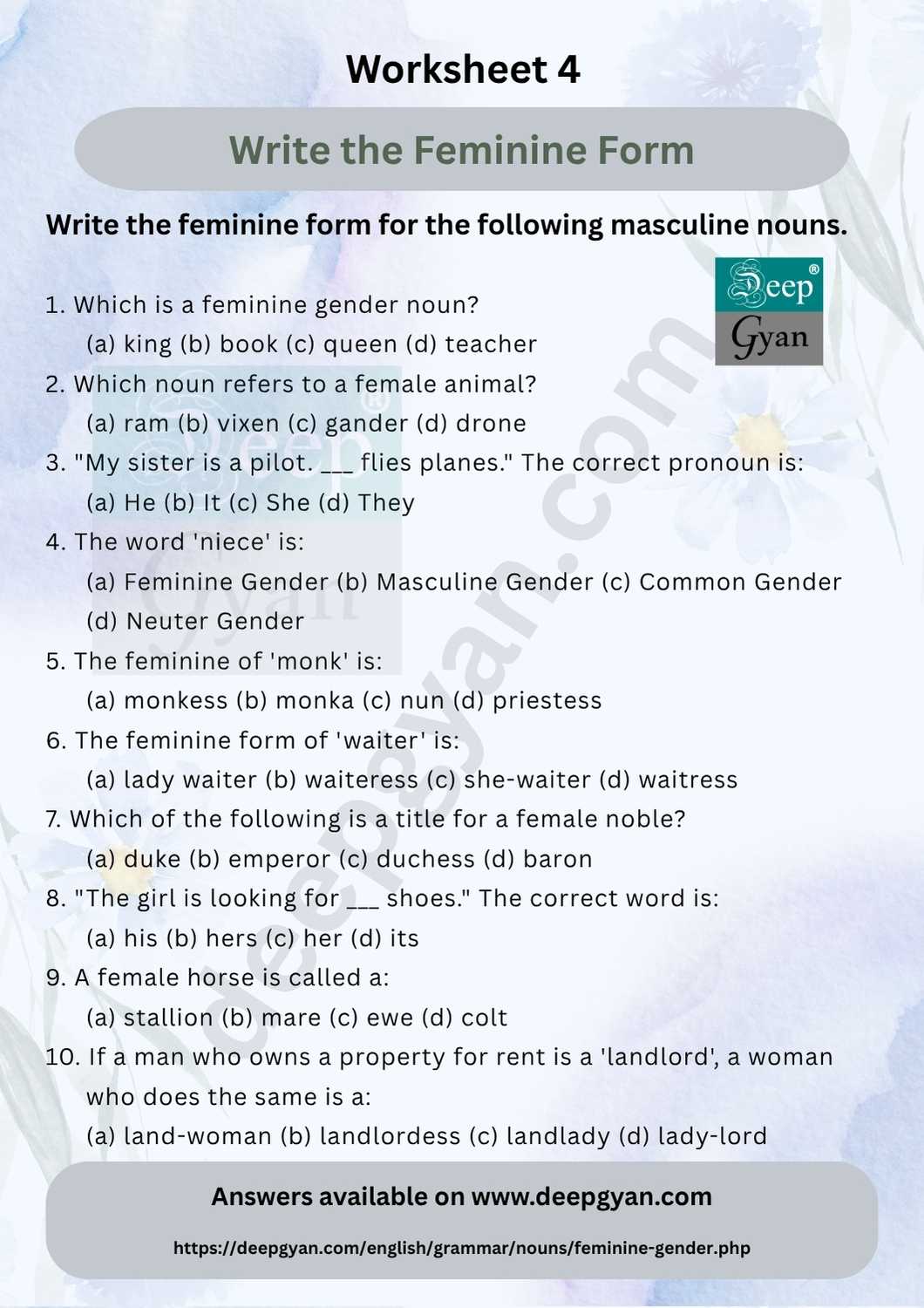
English Grammar: Feminine Gender Quiz

Feminine Gender True/False Worksheet
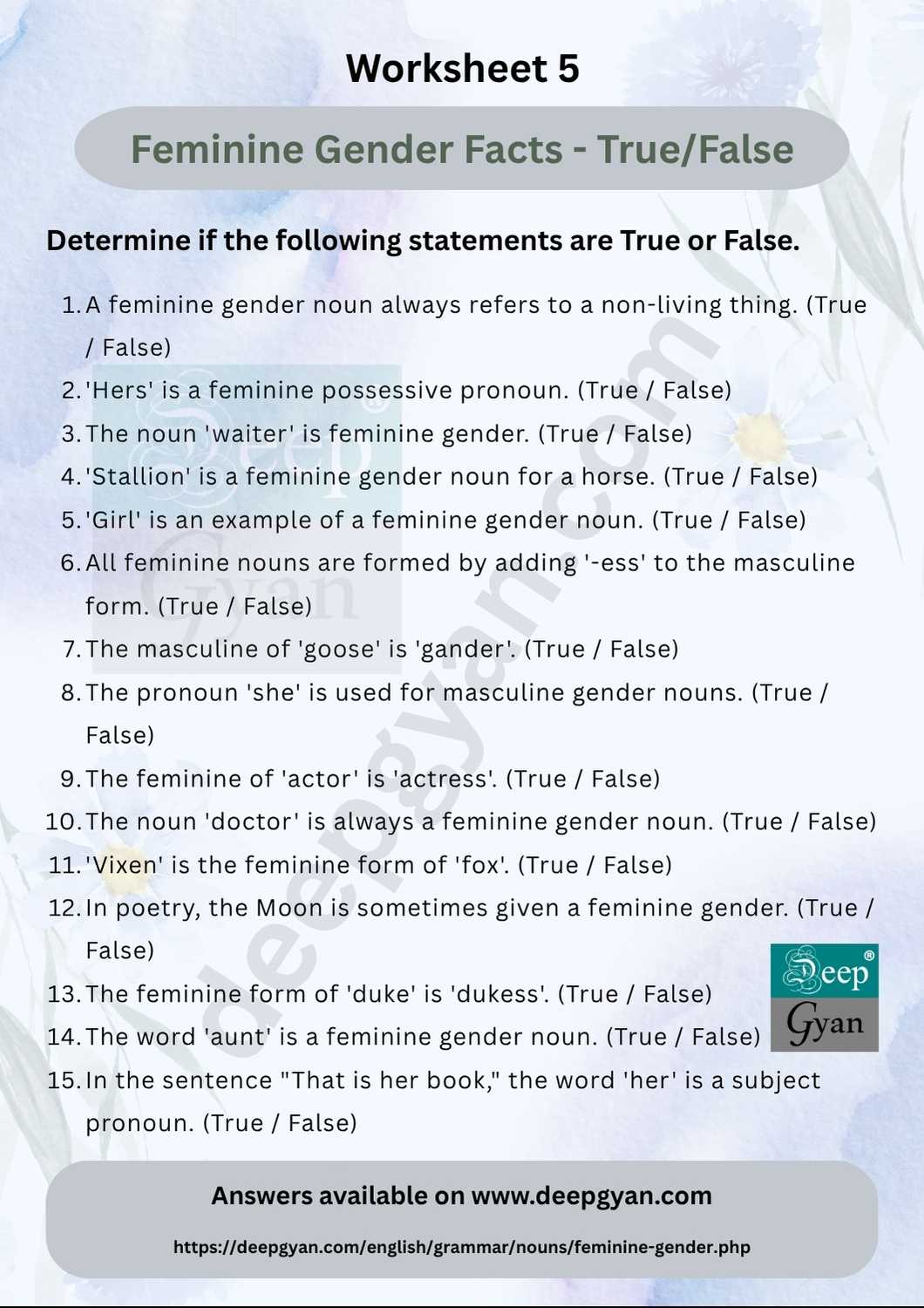
Grammar Facts Quiz: Feminine Gender Edition

Worksheet for Listing Feminine Nouns
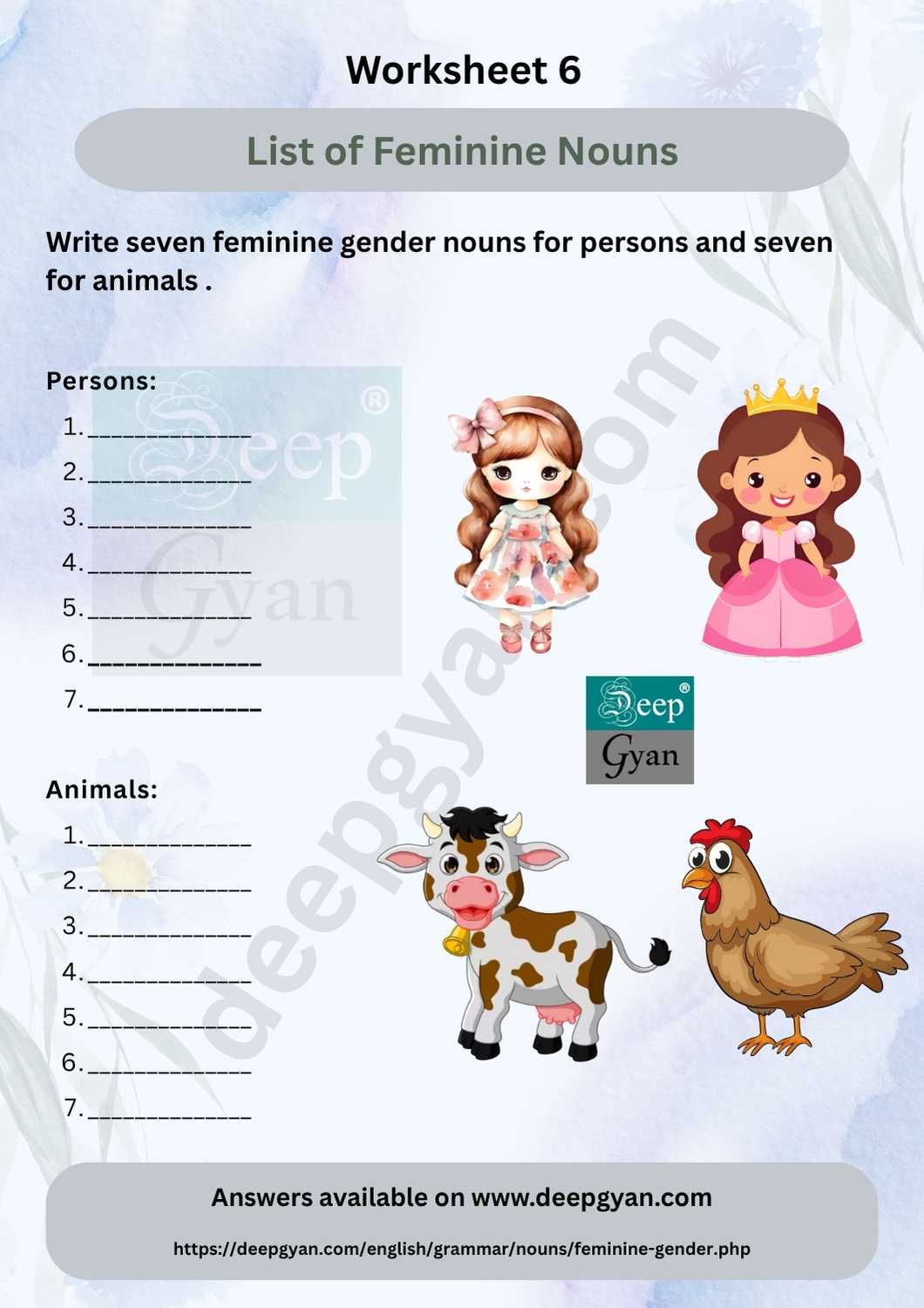
Grammar Challenge: Listing Feminine Nouns

Links of other related pages
Masculine and Feminine of Animals
Masculine and Feminine of Birds
Masculine and Feminine of Fish, Reptiles & Amphibians
100 Examples of Masculine and Feminine gender
Feminine of Nouns starting with 'A'
Feminine of Nouns starting with 'B'
Feminine of Nouns starting with 'C'
Feminine of Nouns starting with 'D'
Feminine of Nouns starting with 'E'
Feminine of Nouns starting with 'F'
Feminine of Nouns starting with 'G'
Feminine of Nouns starting with 'H'
Feminine of Nouns starting with 'I'
Feminine of Nouns starting with 'J'
Feminine of Nouns starting with 'K'
Feminine of Nouns starting with 'L'
Feminine of Nouns starting with 'M'
Feminine of Nouns starting with 'N'
Feminine of Nouns starting with 'O'
Feminine of Nouns starting with 'P'
Feminine of Nouns starting with 'Q'
Feminine of Nouns starting with 'R'
Feminine of Nouns starting with 'S'
Feminine of Nouns starting with 'T'
Feminine of Nouns starting with 'U'
Feminine of Nouns starting with 'V'
Feminine of Nouns starting with 'W'
Feminine of Nouns starting with 'X, Y, Z'
Masculine of Nouns starting with 'A'
Masculine of Nouns starting with 'B'
Masculine of Nouns starting with 'C'
Masculine of Nouns starting with 'D'
Masculine of Nouns starting with 'E'
Masculine of Nouns starting with 'F'
Masculine of Nouns starting with 'G'
Masculine of Nouns starting with 'H'
Masculine of Nouns starting with 'I'
Masculine of Nouns starting with 'J & K'
Masculine of Nouns starting with 'L'
Masculine of Nouns starting with 'M'
Masculine of Nouns starting with 'N'
Masculine of Nouns starting with 'O'
Masculine of Nouns starting with 'P'
Masculine of Nouns starting with 'Q & R'
Masculine of Nouns starting with 'S'
Masculine of Nouns starting with 'T'
Masculine of Nouns starting with 'U & V'
