Noun Gender helps us use correct pronouns (like he, she, it) and possessive adjectives (his, her, its). In English grammar, Gender is a characteristic of nouns that classifies them as masculine, feminine, common, or neuter. While English gender is simpler than in many other languages (as it doesn't usually affect articles or adjectives), it's still an important concept for accurate and natural-sounding English. This guide will explain the different types of gender, show how feminine nouns are formed, provide many examples, and offer noun gender worksheets, suitable for learners from Classes 1 to 10, aligning with NCERT and CBSE guidelines.
Noun Gender: Worksheets, Types, Examples, Rules, PDF Exercises (Class 1-10 NCERT/CBSE)
Your Comprehensive Guide to Noun Genders (Table of Contents)
- What is Gender in Nouns? (Definition and Basic Idea)
- Why is Understanding Noun Gender Important?
- Types of Noun Gender in English Nouns
- Ways of Forming the Feminine of Nouns
- Special Points about Noun Gender
- Summary Table of Gender Types and Formation
- Practice Arena: Exercises on Noun Gender
- Test Your Knowledge: Quizzes on Noun Gender
- Downloadable PDF Worksheet on Noun Gender
- Common Questions About Noun Gender Answered (FAQs)
- Creative Practice: Worksheet Ideas for Noun Gender
- Downloadable Noun Gender Worksheets (Images)
What is Gender in Nouns? (Definition and Basic Idea)
In grammar, Gender refers to the system of classifying nouns as masculine, feminine, common, or neuter. This classification is based on whether the noun refers to a male, a female, either male or female, or an inanimate object/non-living thing.
Basic Idea: Gender helps us understand if a noun relates to male, female, both, or neither.
Think of it like this:
- Masculine: Words for males (e.g., boy, king, lion) → associated with "he/his"
- Feminine: Words for females (e.g., girl, queen, lioness) → associated with "she/her"
- Common: Words for either males or females (e.g., student, doctor, parent) → can be "he/she" or "they"
- Neuter: Words for things without biological sex (e.g., book, table, idea) → associated with "it/its"
Why is Understanding Noun Gender Important?
Knowing the gender of nouns is important for several reasons in English:
- Correct Pronoun Usage: It helps in choosing the correct personal pronouns (he, she, it, they) and possessive pronouns/adjectives (his, her, hers, its, their, theirs).
- Example: John is here. He looks happy. (Masculine noun → Masculine pronoun)
- The book is on the table. It is mine. (Neuter noun → Neuter pronoun)
- Clarity and Precision: Using gender correctly makes your language clearer and more precise.
- Understanding Literature: In literature, authors sometimes use personification, assigning masculine or feminine gender to inanimate objects or abstract ideas to create specific effects.
- Foundation for Other Languages: While English gender is relatively straightforward, understanding the concept is helpful if you learn other languages (like French, Spanish, German, Hindi) where gender affects more parts of speech (articles, adjectives).
Types of Gender in English Nouns
English nouns are generally classified into four genders:
A. Masculine Gender
A noun that refers to a male person or animal is said to be of the Masculine Gender.
Examples:
| Noun | Example Sentence |
|---|---|
| man | The man is reading a newspaper. |
| boy | The boy is playing football. |
| king | The king ruled the kingdom wisely. |
| father | My father is a doctor. |
| brother | His brother is very tall. |
| uncle | My uncle lives in London. |
| lion | The lion is the king of the jungle. |
| rooster | The rooster crowed at dawn. |
| actor | The actor performed his role brilliantly. |
| hero | He is a national hero. |
B. Feminine Gender
A noun that refers to a female person or animal is said to be of the Feminine Gender.
Examples:
| Noun | Example Sentence |
|---|---|
| woman | The woman is a talented artist. |
| girl | The girl is singing a song. |
| queen | The queen wore a beautiful crown. |
| mother | Her mother bakes delicious cakes. |
| sister | My sister is a teacher. |
| aunt | His aunt is visiting them. |
| lioness | The lioness protects her cubs. |
| hen | The hen laid an egg. |
| actress | The actress won an award for her performance. |
| heroine | She is the heroine of the story. |
C. Common Gender
A noun that can refer to either a male or a female is said to be of the Common Gender. These nouns do not specify the sex.
Examples:
| Noun | Example Sentence |
|---|---|
| student | Every student should study hard. (Could be male or female) |
| teacher | The teacher explained the lesson clearly. |
| doctor | The doctor advised him to rest. |
| parent | Every parent wants the best for their child. |
| child | The child was playing in the park. |
| friend | My best friend is very supportive. |
| baby | The baby is sleeping soundly. |
| person | That person seems familiar. |
| artist | The artist created a masterpiece. |
| cousin | My cousin is coming to visit. |
| singer | The singer has a beautiful voice. |
| dancer | The dancer moved gracefully. |
D. Neuter Gender
A noun that refers to a non-living thing (an object or an idea that has no biological sex) is said to be of the Neuter Gender. Young children and animals are sometimes referred to with neuter pronouns if their sex is unknown or irrelevant.
Examples:
| Noun | Example Sentence |
|---|---|
| book | This book is very interesting. |
| table | The table is made of wood. |
| chair | Please take a chair. |
| house | Their house is very big. |
| computer | My computer is not working. |
| pen | Can I borrow your pen? |
| tree | The tree provides shade. |
| stone | He threw a stone into the river. |
| idea | That's a brilliant idea! |
| happiness | Happiness is a state of mind. |
Ways of Forming the Feminine of Nouns
There are several ways to form the feminine gender of nouns from the masculine gender:
1. By Using an Entirely Different Word
For some nouns, the masculine and feminine forms are completely different words.
| Masculine | Feminine | Example (Feminine) |
|---|---|---|
| boy | girl | The girl wore a pink dress. |
| man | woman | That woman is a scientist. |
| father | mother | His mother is a kind lady. |
| brother | sister | My sister plays the piano. |
| husband | wife | His wife is a lawyer. |
| king | queen | The queen addressed the nation. |
| uncle | aunt | My aunt bakes delicious cookies. |
| nephew | niece | His niece is very intelligent. |
| monk/friar | nun | The nun prayed in the chapel. |
| sir | madam | "Good morning, Madam," he said. |
| bachelor | spinster (though 'single woman' is more common now) | She remained a spinster all her life. |
| wizard | witch | The witch cast a spell. |
| gentleman | lady | A lady entered the room. |
| son | daughter | Their daughter is studying abroad. |
| horse/stallion | mare | The mare galloped across the field. |
| bull/ox | cow | The cow gives us milk. |
| rooster/cock | hen | The hen clucked in the yard. |
| dog | bitch (though 'female dog' is often preferred in general conversation) | The bitch had a litter of puppies. |
| drake | duck | The duck swam in the pond. |
| gander | goose | The goose honked loudly. |
| ram | ewe | The shepherd tended to his ewes. |
| fox | vixen | The vixen cared for her cubs. |
2. By Adding a Suffix (like -ess, -ine, -trix, -a)
Many feminine nouns are formed by adding a suffix to the masculine form.
a. Adding -ess without changing the masculine form
| Masculine | Feminine | Example (Feminine) |
|---|---|---|
| author | authoress | The authoress published her new novel. |
| baron | baroness | The Baroness attended the royal ball. |
| count | countess | The Countess lived in a grand castle. |
| giant | giantess | The story featured a fearsome giantess. |
| heir | heiress | She was the sole heiress to the fortune. |
| host | hostess | The hostess greeted the guests warmly. |
| Jew | Jewess | (This term is often considered archaic or offensive; 'Jewish woman' is preferred) |
| lion | lioness | The lioness hunted for her cubs. |
| patron | patroness | She was a generous patroness of the arts. |
| peer | peeress | The peeress had a seat in the House of Lords. |
| poet | poetess | The poetess recited her verses. (Though 'poet' is now common for both) |
| priest | priestess | The ancient temple was served by a priestess. |
| prophet | prophetess | The prophetess foretold future events. |
| shepherd | shepherdess | The shepherdess watched over her flock. |
| steward | stewardess (now often 'flight attendant') | The stewardess served drinks on the plane. |
| viscount | viscountess | The Viscountess was known for her charity. |
b. Adding -ess after dropping the vowel of the masculine ending
| Masculine | Feminine | Example (Feminine) |
|---|---|---|
| actor | actress | The actress received an award. |
| benefactor | benefactress | She was a kind benefactress to the poor. |
| conductor | conductress | The conductress guided the orchestra. (Though 'conductor' is now common for both) |
| enchanter | enchantress | The enchantress wove a magical spell. |
| founder | foundress | She was the foundress of the organization. |
| hunter | huntress | The mythical huntress was swift and skilled. |
| instructor | instructress | The dance instructress was very patient. (Though 'instructor' is now common for both) |
| negro | negress | (These terms are offensive and outdated.) |
| preceptor | preceptress | The young prince had a wise preceptress. |
| prince | princess | The princess waved to the crowd. |
| songster | songstress | The songstress captivated the audience. |
| tempter | temptress | The story warned of the wily temptress. |
| tiger | tigress | The tigress fiercely protected her young. |
| traitor | traitress | She was branded a traitress to her country. |
| waiter | waitress | The waitress took their order. (Though 'server' is now common for both) |
| master | mistress | She was the mistress of the grand estate. |
| murderer | murderess | The murderess was caught by the detective. |
| sorcerer | sorceress | The powerful sorceress lived in the dark forest. |
c. Adding -ess in a more irregular way
| Masculine | Feminine | Example (Feminine) |
|---|---|---|
| duke | duchess | The Duchess attended the charity event. |
| emperor | empress | The Empress ruled over a vast empire. |
| governor | governess | The children had a strict governess. |
| marquis/marquess | marchioness | The Marchioness hosted a lavish party. |
| god | goddess | Athena was the Greek goddess of wisdom. |
d. Other Suffixes (-ine, -trix, -a, etc.)
Some feminine nouns are formed using less common suffixes, often from Latin.
| Masculine | Suffix | Feminine | Example (Feminine) |
|---|---|---|---|
| hero | -ine | heroine | She was the heroine of the film. |
| testator | -trix | testatrix | The testatrix left her estate to her nephew. |
| executor | -trix | executrix | She was appointed executrix of the will. |
| prosecutor | -trix | prosecutrix | The prosecutrix presented the case. |
| administrator | -trix | administratrix | The administratrix managed the affairs. |
| sultan | -a | sultana | The sultana was known for her beauty. |
| signor (Italian) | -a | signora | Signora Rossi greeted them. |
| czar/tsar (Russian) | -ina | czarina/tsarina | The Czarina was a powerful figure. |
| don (Spanish) | -a | doña | Doña Isabella was respected by all. |
3. By Placing a Word Before or After (for Common Gender Nouns)
For common gender nouns, specific gender can be indicated by adding a gender-specific word.
| Common Gender | Masculine Specific | Feminine Specific | Example (Feminine Specific) |
|---|---|---|---|
| student | boy-student / male student | girl-student / female student | The girl-student asked a question. |
| doctor | man-doctor / male doctor | woman-doctor / lady doctor / female doctor | The woman-doctor was very experienced. |
| servant | man-servant | maid-servant / woman-servant | The maid-servant cleaned the rooms. |
| teacher | male teacher | female teacher | My female teacher is very kind. |
| child | male child | female child | They adopted a female child. |
| goat | he-goat / billy-goat | she-goat / nanny-goat | The nanny-goat had two kids. |
| sparrow | cock-sparrow | hen-sparrow | The hen-sparrow built a nest. |
| bear | he-bear | she-bear | The she-bear protected her cubs. |
| cat | tom-cat / he-cat | she-cat / tabby-cat (tabby refers to coat pattern, not always female) | The she-cat purred contentedly. |
| donkey | jackass / he-donkey | jenny-ass / she-donkey | The she-donkey carried the load. |
| peafowl | peacock | peahen | The peahen followed the peacock. |
| milkman | (already masculine) | milkmaid / milkwoman | The milkmaid delivered fresh milk. |
| landlord | (already masculine) | landlady | The landlady collected the rent. |
| grandfather | (already masculine) | grandmother | My grandmother tells wonderful stories. |
Special Points about Noun Gender
Personification: Giving Gender to Inanimate Objects
Sometimes, in literature or figurative language, inanimate objects and abstract ideas are personified and referred to as masculine or feminine. This is a stylistic choice.
- Objects known for strength, power, violence, or grandeur are often treated as Masculine.
- Example: The Sun shed his beams on rich and poor alike.
- Example: Death lays his icy hands on kings.
- Example: Time continues his relentless march.
- Objects known for beauty, gentleness, grace, or fertility are often treated as Feminine.
- Example: The Moon has hidden her face behind a cloud.
- Example: The Earth supports all her creatures.
- Example: Spring has spread her mantle of green over the earth.
- Example: A ship is often referred to as 'she'. (e.g., "She sailed gracefully into the harbor.")
- Example: Countries are sometimes referred to as 'she' when spoken of with affection or as a motherland (e.g., "India is proud of her heritage.")
Gender of Animals
While specific masculine and feminine terms exist for many animals (e.g., lion/lioness, rooster/hen), if the sex is unknown or unimportant, animals are often referred to using neuter pronouns (it/its), especially for smaller or less individualized animals. However, for pets or animals whose sex is known, gendered pronouns (he/she) are commonly used.
- Example: The dog wagged its tail. (Sex unknown/irrelevant)
- Example: My cat, Whiskers, is a male. He loves to sleep.
Summary Table of Gender Types and Formation
| Gender Type | Refers To | Examples | Common Pronoun |
|---|---|---|---|
| Masculine | Male persons or animals | man, boy, king, lion, actor | he, him, his |
| Feminine | Female persons or animals | woman, girl, queen, lioness, actress | she, her, hers |
| Common | Either male or female | student, teacher, doctor, parent, child | he/she, they (singular) |
| Neuter | Non-living things, objects, ideas (sometimes young children/animals) | book, table, house, idea, tree | it, its |
Common Ways to Form Feminine:
- Different word (e.g., king → queen)
- Adding -ess (e.g., actor → actress, lion → lioness)
- Other suffixes (e.g., hero → heroine)
Practice Arena: Exercises on Gender of Nouns
Exercise 1: Identify the Gender
Identify the gender of the underlined noun in each sentence (Masculine, Feminine, Common, or Neuter).
- The king ruled wisely. (__________)
- My teacher is very kind. (__________)
- The book is on the shelf. (__________)
- The actress won an award. (__________)
- A doctor should be patient. (__________)
- The lioness protected her cubs. (__________)
- This chair is broken. (__________)
- My uncle is visiting us. (__________)
- The queen wore a beautiful crown. (__________)
- Every parent loves their child. (__________)
- The rooster wakes us up in the morning. (__________)
- Honesty is the best policy. (__________)
- My cousin can be a boy or a girl. (__________)
- The heroine of the movie was very brave. (__________)
- That tall building is a library. (__________)
Exercise 2: Provide the Opposite Gender
Write the noun of the opposite gender for each of the following. If it's Common or Neuter, it might not have a direct opposite or might require a phrase.
- Masculine: Prince → Feminine: _______
- Feminine: Waitress → Masculine: _______
- Masculine: Stallion → Feminine: _______
- Feminine: Nun → Masculine: _______
- Masculine: Author → Feminine: _______ (traditional)
- Common: Student → Masculine specific: _______ / Feminine specific: _______
- Masculine: Fox → Feminine: _______
- Feminine: Duchess → Masculine: _______
- Masculine: Emperor → Feminine: _______
- Feminine: Bride → Masculine: _______
- Masculine: Sir → Feminine: _______
- Feminine: Cow → Masculine: _______
- Masculine: Wizard → Feminine: _______
- Feminine: Hen → Masculine: _______
- Masculine: Brother → Feminine: _______
Exercise 3: Fill in the Blanks with the Correct Gender Form
Fill in the blanks with the correct gender form of the noun given in brackets.
- The (hero) of the story was a brave young _______. (feminine)
- My (nephew) is very naughty, but my _______ is very calm. (feminine of nephew)
- The (emperor) and the _______ ruled the vast empire together. (feminine of emperor)
- The host greeted his guests, while the _______ ensured everyone was comfortable. (feminine of host)
- A (wizard) uses magic, and so does a _______. (feminine of wizard)
- The (landlord) collected rent from all the tenants, including the _______. (feminine of landlord, if different role) (Or: The landlord and _______ were present.)
- My __________ was a very tall woman. (Feminine of: grandfather)
- The __________ cast a spell on the city. (Feminine of: wizard)
- The __________ of Arabia was a very powerful man. (Masculine of: queen)
- The bride married the __________. (Masculine of: bride)
- "Good morning, __________," said the students. (Feminine of: sir)
- The __________ looked after the gander well. (Feminine of: gander)
- My nephew has bought a __________. (Feminine of: colt)
- The hunter saw a __________ and was thrilled. (Feminine of: stag)
- She handed over a quiver of arrows to the __________. (Common gender for a sports person)
- A noun that refers to a non-living thing is called a noun of __________ gender.
Exercise 4: Identifying Noun Genders in Context
Read the sentences below and identify the gender of the underlined nouns. Write M for Masculine, F for Feminine, C for Common, or N for Neuter in the space provided.
- My brother is a soldier. (for brother) _____, (for soldier) _____
- The queen received the prime minister at the airport. (for queen) _____
- Good students respect their teachers. (for students) _____, (for teachers) _____
- The tiger and the tigress are sleeping under a tree. (for tiger) _____, (for tigress) _____, (for tree) _____
- This atlas belongs to my aunt. (for atlas) _____, (for aunt) _____
- The ship lost her boats in the storm. (for ship, personified) _____
- The clerk is waiting for the postmaster. (for clerk) _____, (for postmaster) _____
- My mother sewed a dress. (for mother) _____, (for dress) _____
- A leopard runs very fast to catch its prey. (for leopard) _____, (for prey) _____
- The children played tricks on their parents. (for children) _____, (for parents) _____
Exercise 5: Matching Genders
Match the masculine nouns in Column A with their feminine counterparts in Column B.
| Column A (Masculine) | Column B (Feminine) |
|---|---|
| 1. bull | a. witch |
| 2. nephew | b. mare |
| 3. wizard | c. wife |
| 4. duke | d. cow |
| 5. horse | e. niece |
| 6. husband | f. goose |
| 7. gander | g. duchess |
| 8. monk | h. vixen |
| 9. fox | i. nun |
| 10. bachelor | j. spinster |
Exercise 6: Gender Conversion Table
Fill in the missing gender in the table below. Some feminine nouns are formed by adding "-ess".
| Masculine | Feminine |
|---|---|
| host | _______ |
| _______ | lioness |
| emperor | _______ |
| prince | _______ |
| actor | _______ |
| grandfather | _______ |
| landlord | _______ |
| _______ | mistress |
| milkman | _______ |
| he-goat | _______ |
Test Your Knowledge: Quizzes on Gender of Nouns
Quiz 1: Multiple Choice - Identifying Gender
Choose the correct gender or answer for the given question.
- Noun: Parent
(a) Masculine (b) Feminine (c) Common (d) Neuter - Noun: Table
(a) Masculine (b) Feminine (c) Common (d) Neuter - Noun: Queen
(a) Masculine (b) Feminine (c) Common (d) Neuter - Noun: Rooster
(a) Masculine (b) Feminine (c) Common (d) Neuter - Noun: Artist
(a) Masculine (b) Feminine (c) Common (d) Neuter - What is the masculine gender of 'vixen'?
(a) Foxess (b) Wolf (c) Fox (d) Vixo - Which of the following is a neuter gender noun?
(a) Doctor (b) Baby (c) Computer (d) Friend - The feminine of 'duke' is:
(a) Duke-ess (b) Dukess (c) Lady Duke (d) Duchess - 'Heir' is to 'Heiress' as 'Actor' is to:
(a) Actoress (b) Actress (c) She-actor (d) Actorine - Which noun is of Common Gender?
(a) Man (b) Woman (c) Person (d) Gentleman - The feminine of 'monk' is:
(a) Monka (b) Monkess (c) Nun (d) She-monk - What is the masculine of 'ewe'?
(a) Sheep (b) Lamb (c) Ram (d) Billy-goat - Which of these is always Feminine?
(a) Child (b) Cousin (c) Niece (d) Singer - The noun 'chair' is of what gender?
(a) Masculine (b) Feminine (c) Common (d) Neuter - The masculine of 'witch' is:
(a) Witcheo (b) He-witch (c) Wizard / Warlock (d) Sorcerer
Quiz 2: True or False - Gender Facts
Determine if the following statements are True or False.
- The noun 'book' is of feminine gender. (True / False)
- 'Student' is an example of common gender. (True / False)
- The feminine of 'fox' is 'foxess'. (True / False)
- Neuter gender nouns refer to male animals. (True / False)
- The word 'heir' has a feminine form 'heiress'. (True / False)
- All feminine nouns are formed by adding '-ess' to the masculine form. (True / False)
- 'Parent' is a common gender noun. (True / False)
- The masculine of 'goose' is 'gander'. (True / False)
- Nouns referring to non-living things are always masculine. (True / False)
- The pronoun 'it' is used for neuter gender nouns. (True / False)
- 'Bridegroom' is the feminine of 'bride'. (True / False)
- 'Lady' is the feminine of 'gentleman'. (True / False)
- 'Poetess' is the only correct term for a female poet. (True / False)
- 'Chairperson' is a common gender term for 'chairman' or 'chairwoman'. (True / False)
- In personification, the sun is sometimes given a masculine gender. (True / False)
Downloadable PDF Worksheets on Nouns Gender
For comprehensive practice on identifying and forming nouns, download our specially designed PDF worksheet. It includes a variety of exercises, including matching, fill-in-the-blanks, and conversion tasks, suitable for Class 1, Class 2, Class 3, Class 4, Class 5, Class 6, Class 7 and Class 8. An answer link is included.
Download Worksheets on Noun (Mixed Exercises)
Download Worksheets on Animals and Birds Gender
Download Worksheets on Noun Gender
Download Worksheets on Feminine Gender
Download Worksheets on Masculine Gender
Download PDF of List of Masculine & Feminine Gender
Download PDF of Change the Gender in Sentences
Download PDF of Masculine and Feminine Genders Worksheets - Fill in the Blanks
Download PDF of Masculine and Feminine Genders Worksheets - Match the Pairs
Download PDF of Masculine and Feminine Genders Worksheets - Write the Opposite Genders
Common Questions About Gender of Nouns Answered (FAQs)
Q1: Does English have grammatical gender like French or Spanish?
No, not in the same way. English gender is primarily natural gender, meaning it's based on the biological sex of people and animals, or the lack of sex for inanimate objects. Unlike languages like French, Spanish, or German, English nouns do not typically require articles (like 'the' or 'a') or adjectives to change form based on the noun's gender. The main impact of gender in English is on pronoun selection (he/she/it).
Q2: What is 'common gender'?
A noun of Common Gender can refer to either a male or a female. Examples include student, teacher, doctor, child, parent, friend, artist, cousin. When referring to a specific individual whose sex is known, appropriate gendered pronouns are used. If the sex is unknown or if referring generally, 'they/them/their' is increasingly used as a singular pronoun, or phrases like 'he or she' can be used.
Q3: Are all animals assigned a masculine or feminine gender?
Many animals have distinct masculine and feminine terms (e.g., lion/lioness, bull/cow, rooster/hen). However, for many other animals, there isn't a specific gendered term, or the common gender term is used for both (e.g., 'fish', 'bird', 'snake'). Often, if the sex is unknown or irrelevant, the neuter pronoun 'it' is used, especially for animals not considered as individuals (like insects). For pets or animals whose sex is known, 'he' or 'she' is common.
Q4: What is personification in relation to gender?
Personification is a literary device where inanimate objects, abstract ideas, or animals are given human qualities or characteristics. This can include assigning them a masculine or feminine gender, often based on traditional associations (e.g., the Sun as 'he' for strength, the Moon or Earth as 'she' for beauty or nurturing qualities). Ships and countries are also often referred to as 'she'.
Q5: Why are some feminine forms like 'authoress' or 'poetess' less common now?
Many traditionally feminine forms ending in '-ess' (like authoress, poetess, sculptress) are becoming less common. This is because the masculine form (author, poet, sculptor) is now widely accepted as a common gender term, referring to anyone in that profession regardless of sex. Using these gender-neutral terms is often seen as more inclusive and less diminutive. However, some '-ess' forms like 'actress', 'princess', or 'lioness' remain standard.
Creative Practice: Worksheet Ideas for Gender of Nouns
Adapt these ideas for different class levels:
- Gender Match-Up (Basic): Draw lines to match masculine nouns (e.g., boy, king) to their feminine counterparts (e.g., girl, queen).
- "He, She, It" Sort (Basic): Provide a list of nouns or pictures, and have students sort them under columns labeled "He" (Masculine), "She" (Feminine), and "It" (Neuter). Add a "He/She" column for Common Gender.
- Feminine Form Fill-Ins (Intermediate): Give masculine nouns and ask students to write the correct feminine form (e.g., "Masculine: tiger, Feminine: _______").
- Gender Detective in Sentences (Intermediate): Students read sentences, identify nouns, and state their gender.
- Create a Family Tree (All Levels): Students draw a family tree and label members with gendered nouns (father, mother, uncle, aunt, son, daughter, grandfather, grandmother, etc.).
- Personification Story (Advanced): Ask students to write a short story where they personify an inanimate object (like the wind or a mountain) and assign it a gender, using appropriate pronouns.

Downloadable Noun Gender Worksheets (Images)
Noun Gender Worksheet with Answers
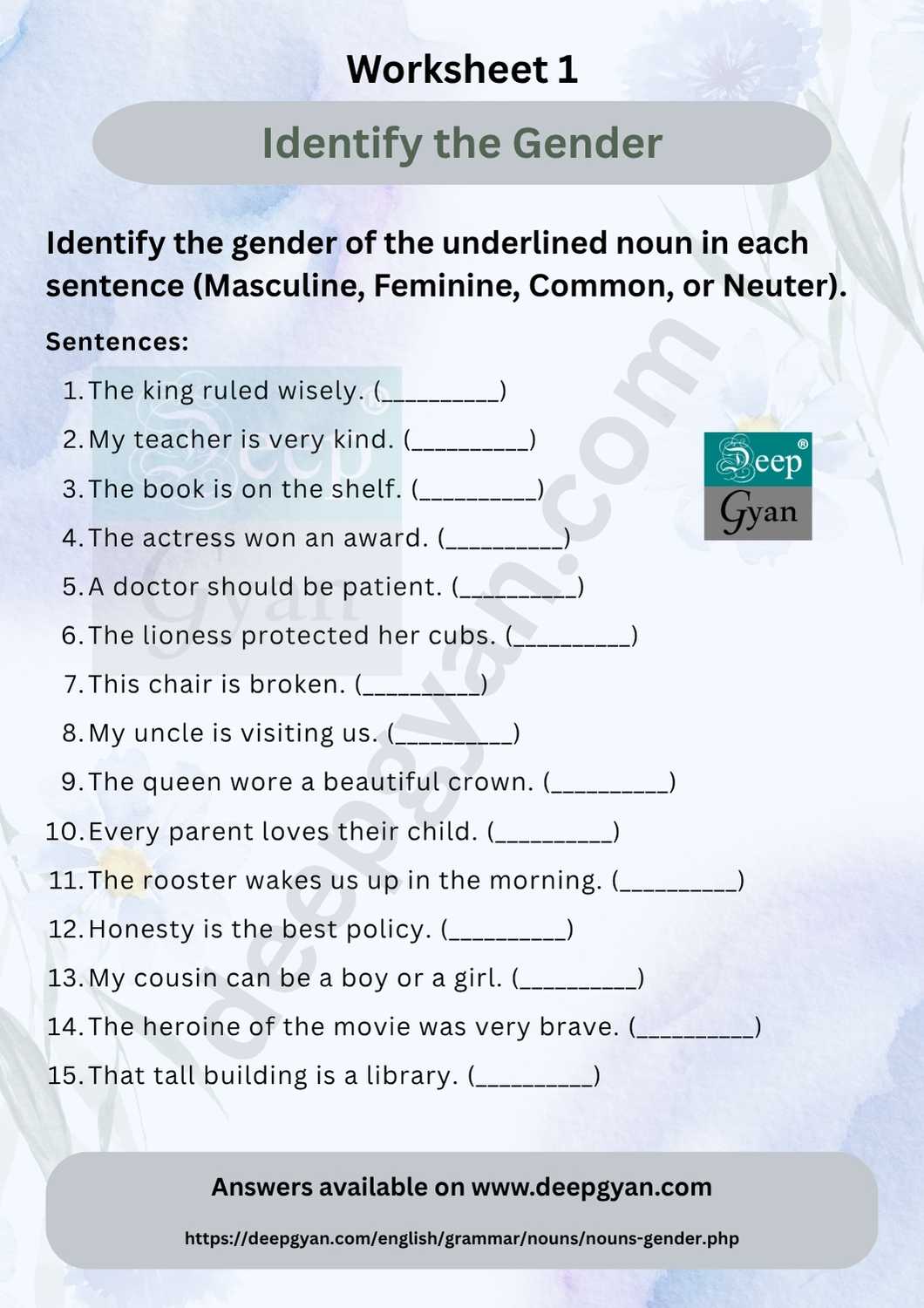
Noun Gender Worksheet with Answers- Identify and Classify Nouns Gender

Give the Opposite Gender Worksheet
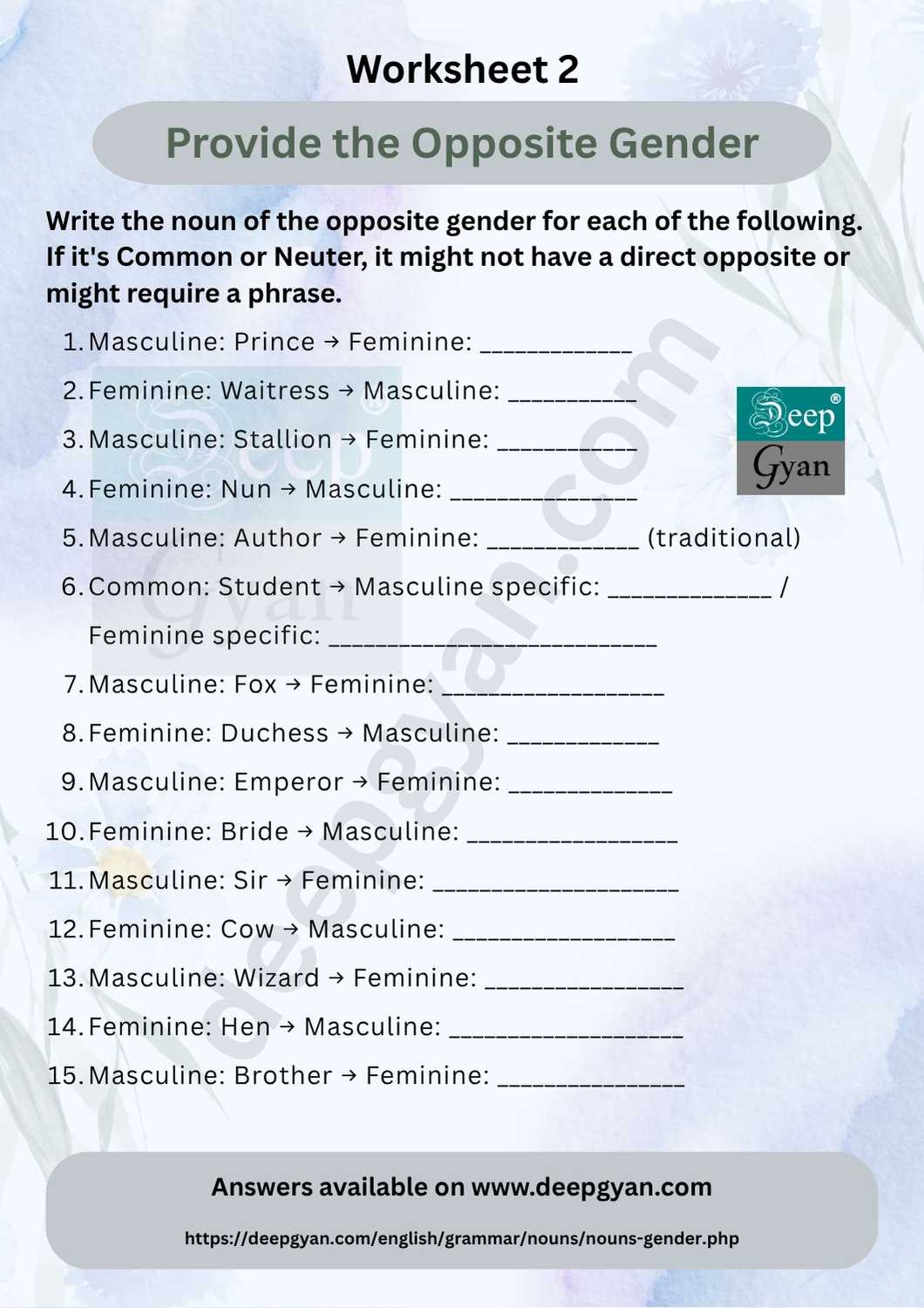
Noun Gender Worksheet with Answers- Give the Opposite Gender

Worksheet on Noun Gender with Answer
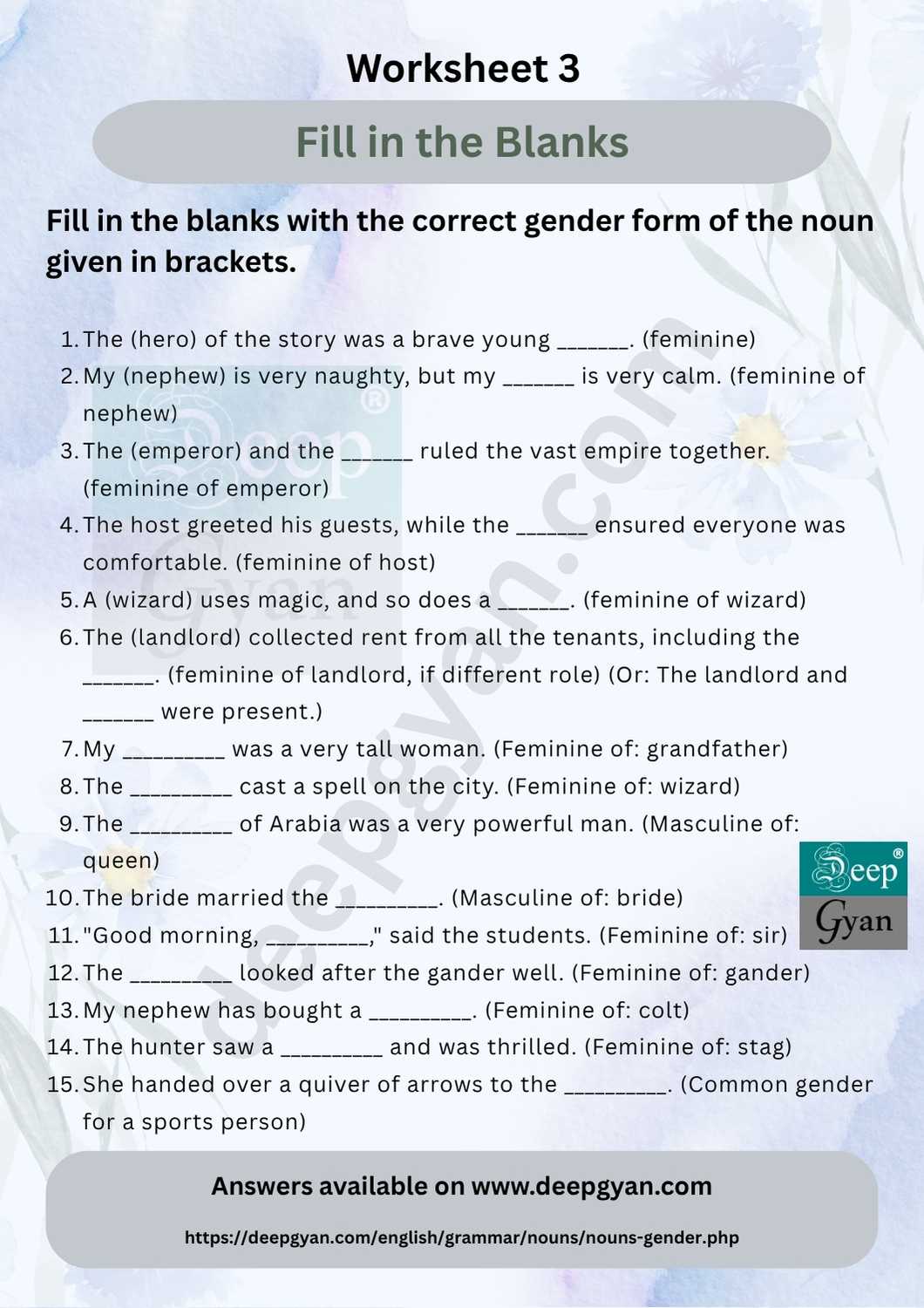
Worksheet on Noun Gender with Answer - Fill in the Blanks

Identifying Noun Genders Worksheet
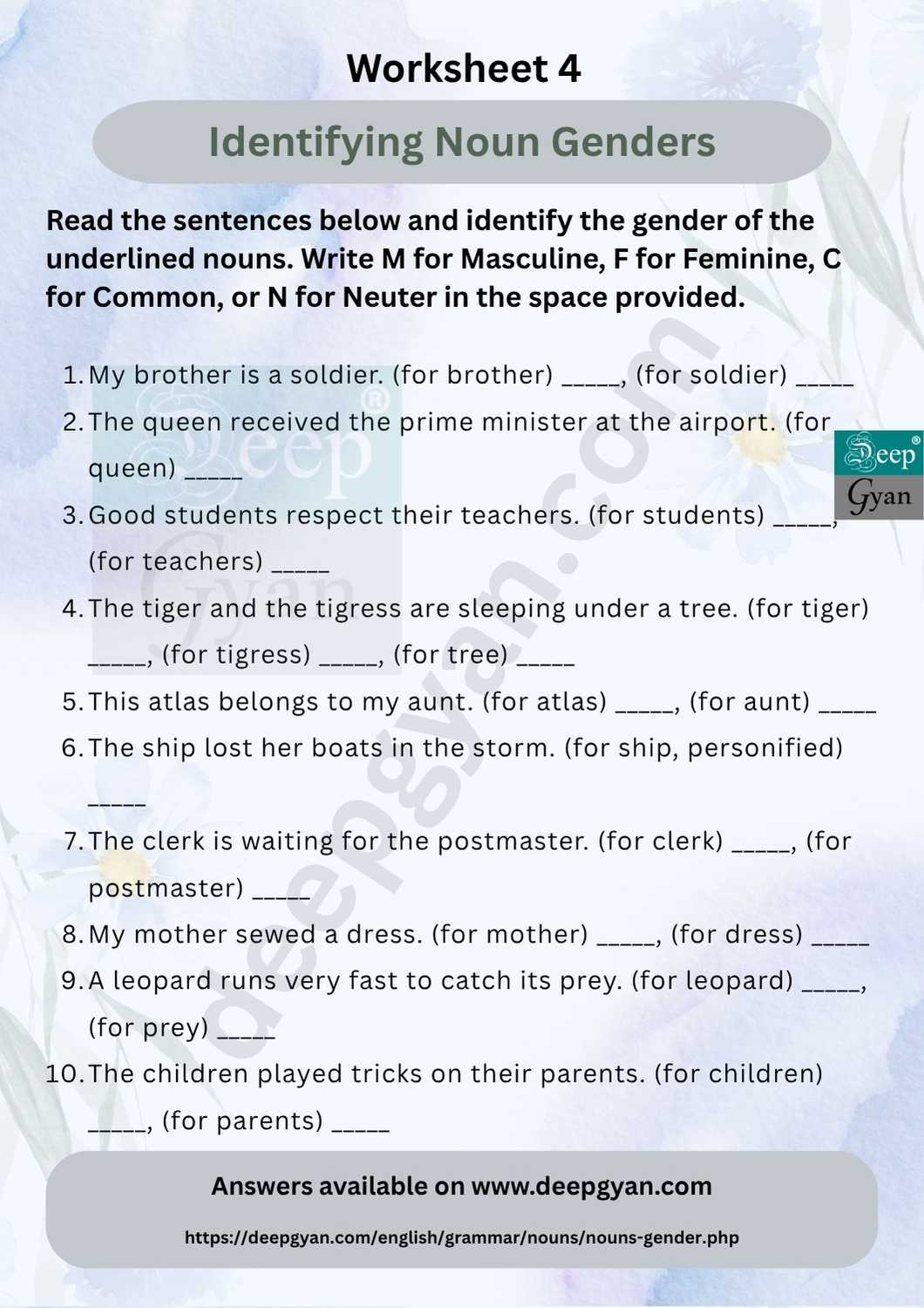
Identifying Noun Genders Worksheet

Match the Genders Worksheet with Answer
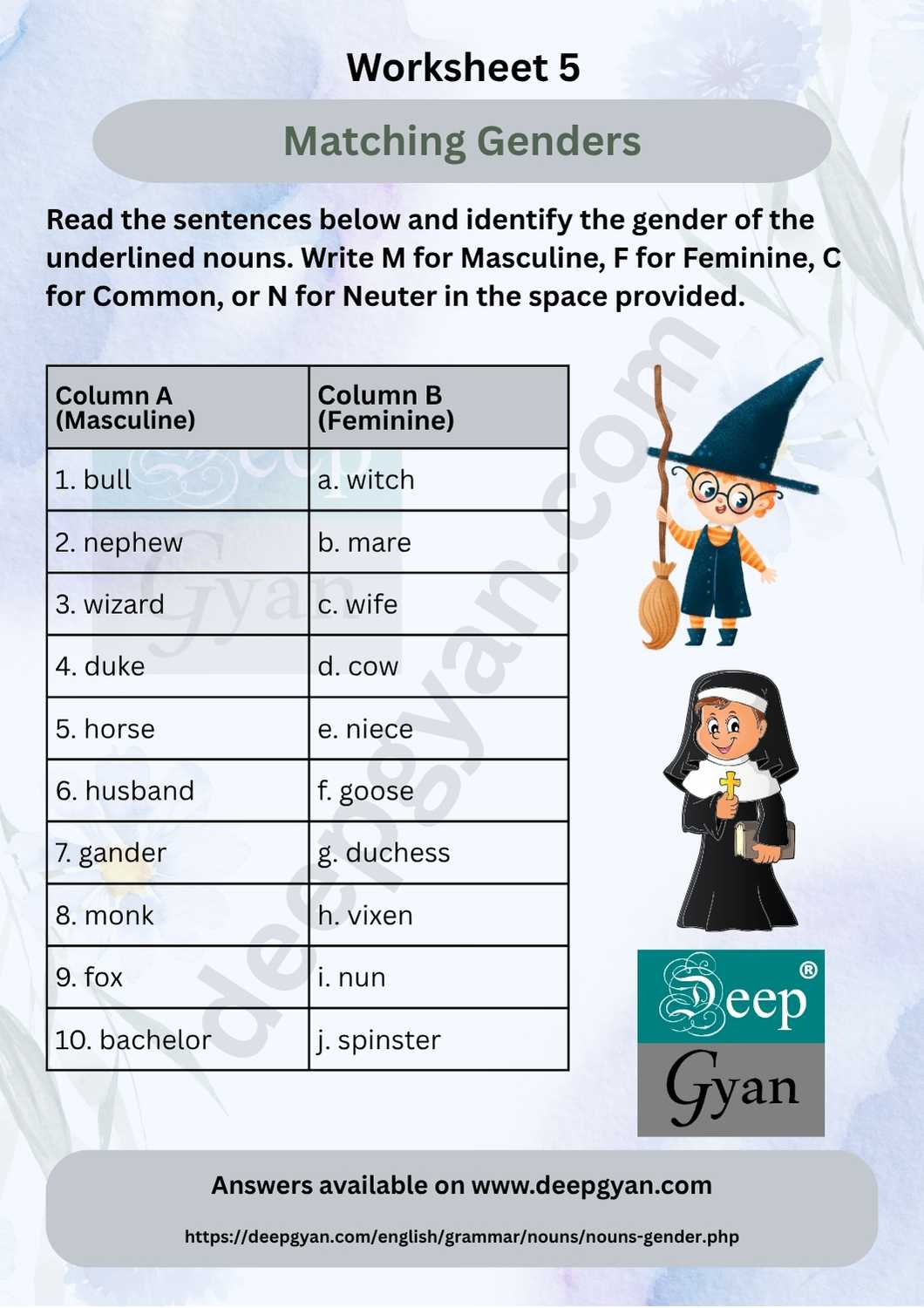
Match the Genders Worksheet with Answer

Change the Gender Worksheet with Answers
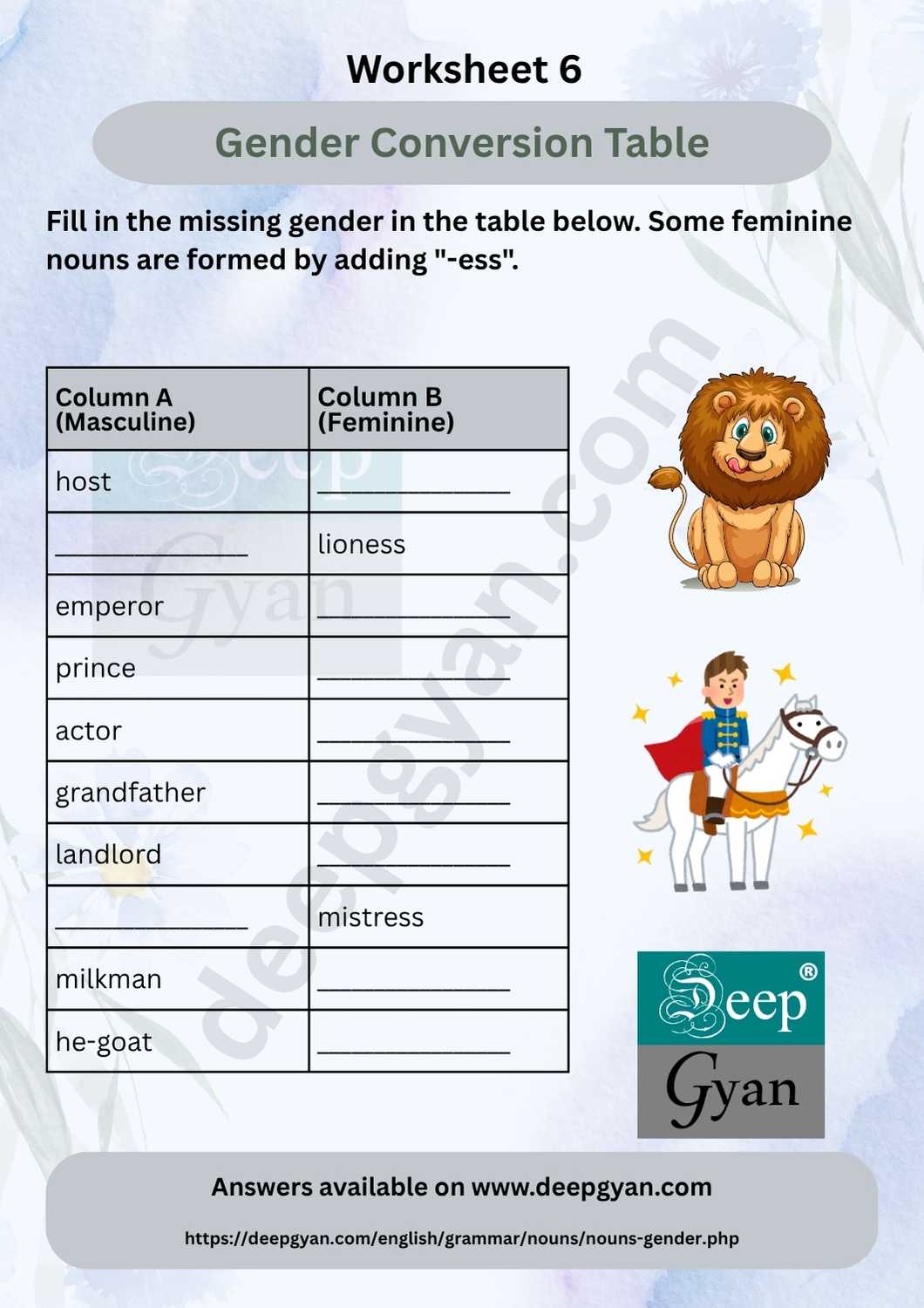
Change the Gender Worksheet with Answers

Free Noun Gender Quiz with Answers (MCQs)
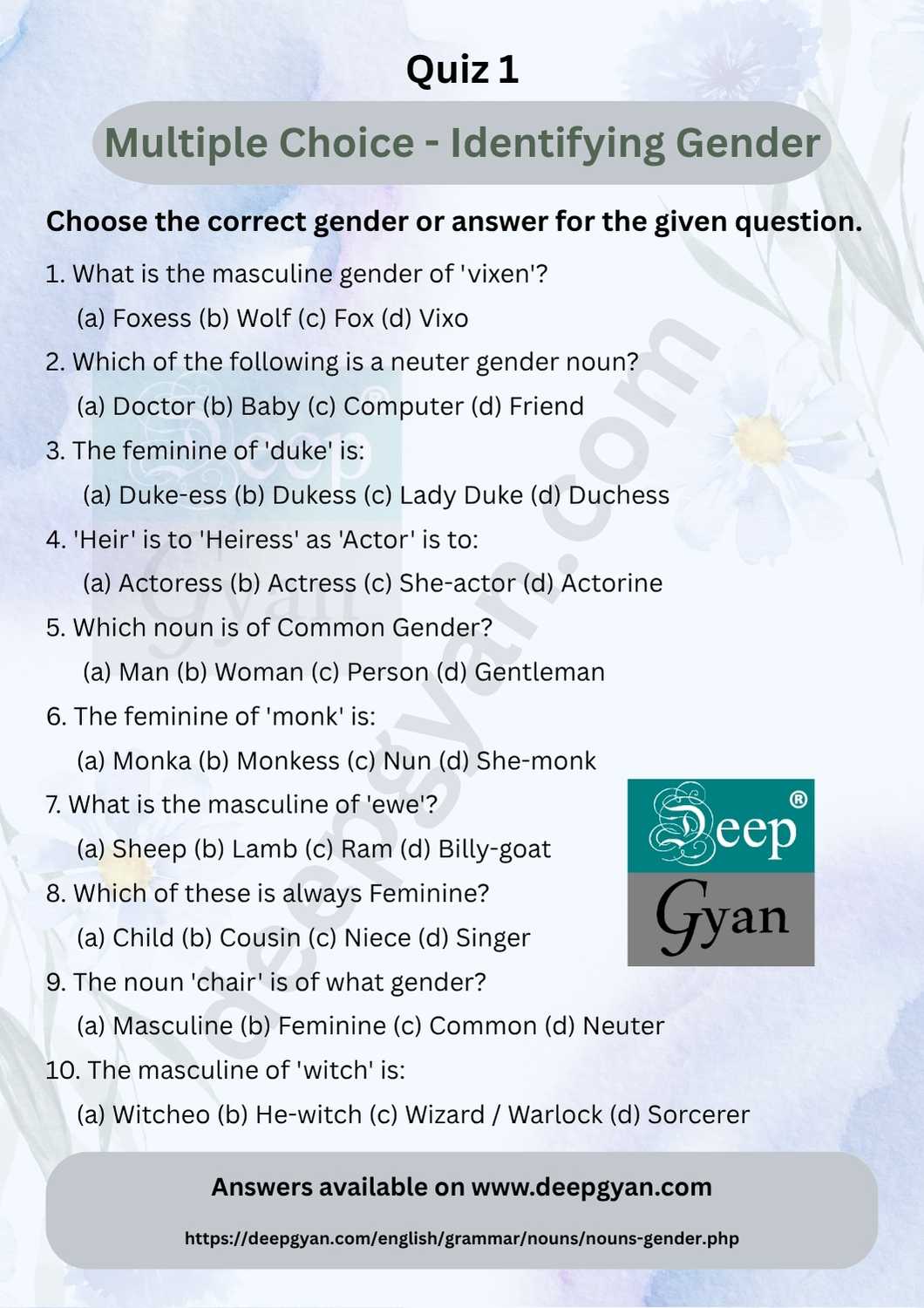
Free Quiz on Noun Gender with Answers - Multiple Choice Questions on Nouns Gender

Free Nouns Gender True or False Questions
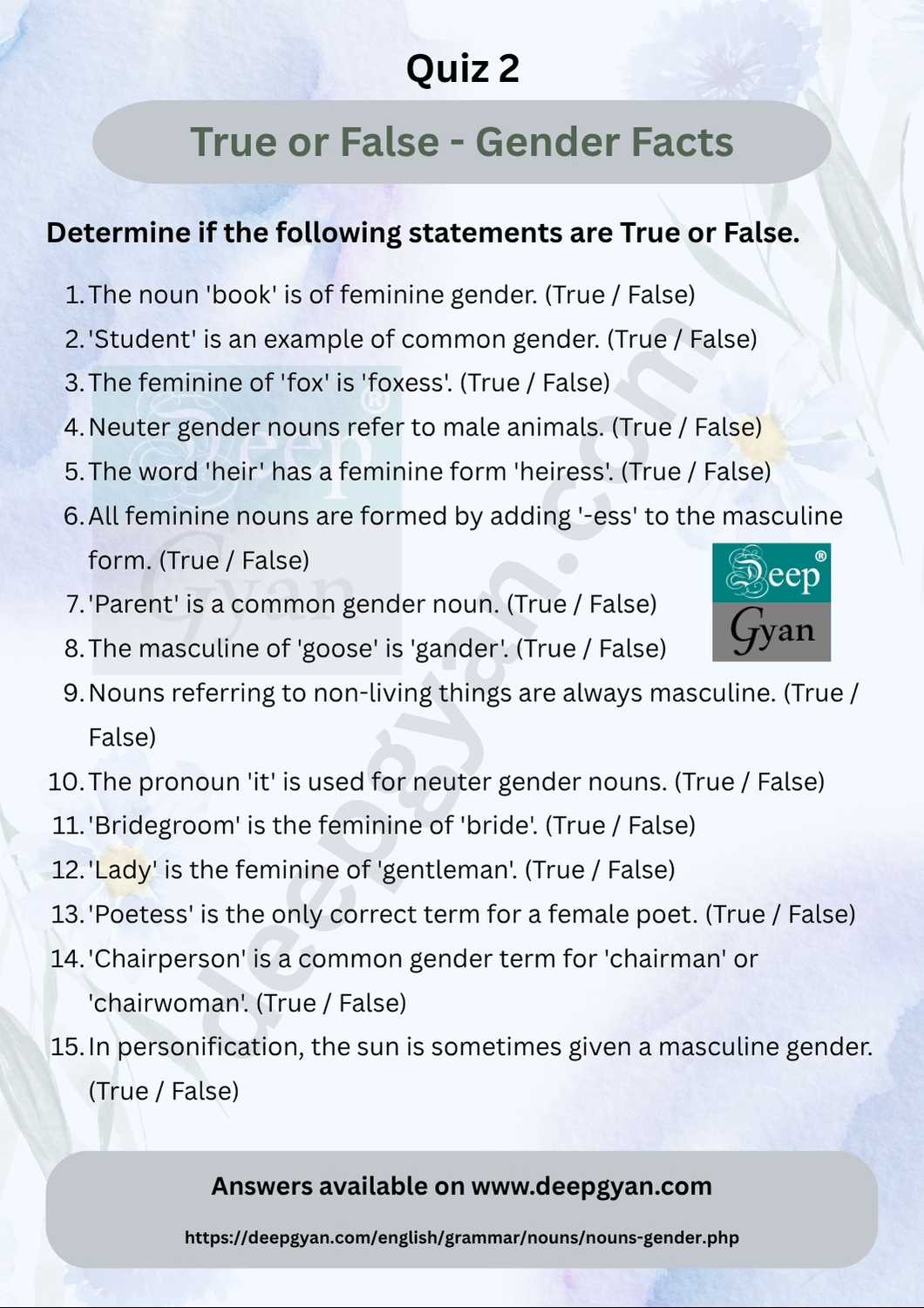
True or False Questions on Nouns Gender
Links of other related pages
Masculine and Feminine of Animals
Masculine and Feminine of Birds
Masculine and Feminine of Fish, Reptiles & Amphibians
100 Examples of Masculine and Feminine gender
Feminine of Nouns starting with 'A'
Feminine of Nouns starting with 'B'
Feminine of Nouns starting with 'C'
Feminine of Nouns starting with 'D'
Feminine of Nouns starting with 'E'
Feminine of Nouns starting with 'F'
Feminine of Nouns starting with 'G'
Feminine of Nouns starting with 'H'
Feminine of Nouns starting with 'I'
Feminine of Nouns starting with 'J'
Feminine of Nouns starting with 'K'
Feminine of Nouns starting with 'L'
Feminine of Nouns starting with 'M'
Feminine of Nouns starting with 'N'
Feminine of Nouns starting with 'O'
Feminine of Nouns starting with 'P'
Feminine of Nouns starting with 'Q'
Feminine of Nouns starting with 'R'
Feminine of Nouns starting with 'S'
Feminine of Nouns starting with 'T'
Feminine of Nouns starting with 'U'
Feminine of Nouns starting with 'V'
Feminine of Nouns starting with 'W'
Feminine of Nouns starting with 'X, Y, Z'
Masculine of Nouns starting with 'A'
Masculine of Nouns starting with 'B'
Masculine of Nouns starting with 'C'
Masculine of Nouns starting with 'D'
Masculine of Nouns starting with 'E'
Masculine of Nouns starting with 'F'
Masculine of Nouns starting with 'G'
Masculine of Nouns starting with 'H'
Masculine of Nouns starting with 'I'
Masculine of Nouns starting with 'J & K'
Masculine of Nouns starting with 'L'
Masculine of Nouns starting with 'M'
Masculine of Nouns starting with 'N'
Masculine of Nouns starting with 'O'
Masculine of Nouns starting with 'P'
Masculine of Nouns starting with 'Q & R'
Masculine of Nouns starting with 'S'
Masculine of Nouns starting with 'T'
Masculine of Nouns starting with 'U & V'