In English grammar, Gender is a way of classifying nouns and pronouns as masculine, feminine, common, or neuter. Understanding the Masculine and Feminine Gender is particularly important for correct pronoun usage and for referring to people and animals accurately. Masculine gender refers to male persons or animals, while feminine gender refers to female persons or animals. This page provides a detailed explanation of masculine and feminine genders, rules for their formation, an extensive A-Z list, examples, common mistakes, exercises, quizzes, and a downloadable PDF, designed for students from Class 1 to Class 8 (NCERT/CBSE syllabus).
List of Masculine and Feminine Gender
Your Comprehensive Guide to Masculine and Feminine Gender (Table of Contents)
- What is Gender in Grammar?
- Understanding Masculine Gender
- Understanding Feminine Gender
- Ways to Form Feminine Gender from Masculine Gender
- Comprehensive List of 100+ Masculine and Feminine Gender Nouns (A-Z Table)
- Example of 100+ Masculine and Feminine Gender Nouns (A-Z Table)
- Common Gender Nouns (Brief Overview)
- Neuter Gender Nouns (Brief Overview)
- Importance of Understanding Gender in Sentences
- Practice Arena: Exercises on Masculine and Feminine Gender
- Test Your Knowledge: Quizzes on Masculine and Feminine Gender
- Downloadable PDF Worksheet on Masculine and Feminine Gender
- Common Questions About Masculine and Feminine Gender Answered (FAQs)
- Creative Practice: Worksheet Ideas for Masculine and Feminine Gender
- List of Genders
What is Gender in Grammar?
In grammar, Gender refers to the classification of nouns and pronouns as masculine, feminine, common, or neuter. This classification is based on the sex (for living beings) or lack of sex (for non-living things) of the person, animal, or object the noun refers to.
The primary focus of this page is on Masculine and Feminine Gender, which apply mainly to people and animals.
- Masculine Gender: Nouns and pronouns that refer to males (e.g., man, boy, king, he, lion, rooster).
- Feminine Gender: Nouns and pronouns that refer to females (e.g., woman, girl, queen, she, lioness, hen).
Understanding gender helps in using correct pronouns (he/she, his/her) and specific gendered nouns.
Understanding Masculine Gender
A noun or pronoun is said to be of the Masculine Gender if it refers to a male person or animal.
Examples of Masculine Gender Nouns:
- Persons: father, son, brother, uncle, king, prince, actor, hero, wizard, gentleman, husband, boy, man.
- Animals: lion, tiger, dog (male context), bull, rooster, stallion, drake, gander, fox (male).
Pronouns used for Masculine Gender: he, him, his.
- Example: The king entered the hall. He looked regal. His crown shone brightly.
Understanding Feminine Gender
A noun or pronoun is said to be of the Feminine Gender if it refers to a female person or animal.
Examples of Feminine Gender Nouns:
- Persons: mother, daughter, sister, aunt, queen, princess, actress, heroine, witch, lady, wife, girl, woman.
- Animals: lioness, tigress, bitch (female dog), cow, hen, mare, duck (female), goose (female), vixen.
Pronouns used for Feminine Gender: she, her, hers.
- Example: The queen greeted her people. She smiled warmly. The welcome was all hers.
Ways to Form Feminine Gender from Masculine Gender
There are several common ways to form the feminine gender of nouns from their masculine counterparts:
1. By Using an Entirely Different Word
In many cases, the masculine and feminine forms are completely different words.
- Boy → Girl
- Man → Woman
- Father → Mother
- Brother → Sister
- Uncle → Aunt
- King → Queen
- Husband → Wife
- Bachelor → Spinster / Maiden
- Monk → Nun
- Horse/Stallion → Mare
- Bull/Ox → Cow
- Cock/Rooster → Hen
- Dog → Bitch
- Gander → Goose
- Drake → Duck
2. By Adding the Suffix "-ess" (and its variations like -ine, -trix, -a)
This is a common way to form the feminine gender, sometimes with slight modifications to the masculine form.
- Adding -ess directly:
- Author → Authoress
- Host → Hostess
- Lion → Lioness
- Poet → Poetess
- Shepherd → Shepherdess
- Baron → Baroness
- Giant → Giantess
- Removing the last vowel of the masculine form and adding -ess:
- Actor → Actress (o removed)
- Hunter → Huntress (e removed)
- Tiger → Tigress (e removed)
- Waiter → Waitress (e removed)
- Benefactor → Benefactress (o removed)
- Enchanter → Enchantress (e removed)
- Founder → Foundress (e removed)
- Inspector → Inspectress (o removed)
- Instructor → Instructress (o removed)
- Preceptor → Preceptress (o removed)
- Songster → Songstress (e removed)
- Tempter → Temptress (e removed)
- Traitor → Traitress (o removed)
- Irregular addition of -ess:
- Duke → Duchess
- Emperor → Empress
- Governor → Governess
- Master → Mistress
- Murderer → Murderess
- Sorcerer → Sorceress
3. By Using Other Suffixes (e.g., -ine, -a, -trix)
Some masculine nouns form their feminine by adding different suffixes.
- Hero → Heroine
- Testator → Testatrix
- Czar → Czarina
- Sultan → Sultana
- Signor → Signora
4. By Changing Part of a Compound Word
In compound nouns, often the masculine or feminine part of the word is changed.
- Grandfather → Grandmother
- Son-in-law → Daughter-in-law
- Manservant → Maidservant
- Landlord → Landlady
- Milkman → Milkmaid / Milkwoman
- Peacock → Peahen
- He-goat → She-goat / Nanny-goat
- Cock-sparrow → Hen-sparrow
- Headmaster → Headmistress
- Policeman → Policewoman
Example of Masculine and Feminine Gender Nouns (A-Z Table)
Below is an extensive list of nouns with their corresponding masculine and feminine genders. This A-Z list will help you learn and recall these forms.
| Feminine | Masculine |
|---|---|
| Abbess | Abbot |
| Actress | Actor |
| Aunt | Uncle |
| Authoress | Author |
| Baroness | Baron |
| Bee | Drone |
| Benefactress | Benefactor |
| Bitch | Dog |
| Bride | Bridegroom, Groom |
| Conductress | Conductor |
| Countess | Earl, Count |
| Cow | Bull, Ox, Bull (or ox) |
| Czarina | Czar |
| Daughter | Son |
| Daughter-in-law | Son-in-law |
| Doe | Buck, Stag |
| Duchess | Duke |
| Duck | Drake |
| Empress | Emperor |
| Enchantress | Enchanter |
| Ewe | Ram |
| Filly | Colt |
| Foundress | Founder |
| Giantess | Giant |
| Girl | Boy |
| Goddess | God |
| Goose | Gander |
| Governess | Governor, Tutor |
| Grandaunt | Granduncle |
| Granddaughter | Grandson |
| Grandmother | Grandfather |
| Great aunt | Great uncle |
| Headmistress | Headmaster |
| Heifer | Bullock, Steer |
| Heiress | Heir |
| Hen | Cock, Rooster |
| Hen-sparrow | Cock-sparrow |
| Heroine | Hero |
| Hind | Stag, Hart |
| Hostess | Host |
| Huntress | Hunter |
| Inspectress | Inspector |
| Instructress | Instructor |
| Jewess | Jew |
| Lady | Lord, Gentleman |
| Landlady | Landlord |
| Lass | Lad |
| Lioness | Lion |
| Ma'am | Sir |
| Madam | Sir |
| Maid servant | Manservant, Man servant |
| Maiden | Bachelor, Youth |
| Mamma | Papa |
| Manageress | Manager |
| Marchioness | Marquis |
| Mare | Horse, Stallion |
| Matriarch | Patriarch |
| Mayoress | Mayor |
| Milkmaid | Milkman |
| Milkwoman | Milkman |
| Mistress | Master |
| Mother | Father |
| Mother-in-law | Father-in-law |
| Mrs | Mr |
| Murderess | Murderer |
| Nanny-goat | Billy-goat |
| Negress | Negro |
| Niece | Nephew |
| Nun | Monk, Friar |
| Patroness | Patron |
| Peahen | Peacock |
| Peeress | Peer |
| Poetess | Poet |
| Policewoman | Policeman |
| Postmistress | Postmaster |
| Preceptress | Preceptor |
| Priestess | Priest |
| Princess | Prince |
| Prophetess | Prophet |
| Queen | King |
| Roe | Hart |
| Saleswoman | Salesman |
| Seamstress | Seamster, Tailor |
| She-bear | He-bear |
| She-goat | He-goat |
| Shepherdess | Shepherd |
| Signora | Signor |
| Sister | Brother |
| Songstress | Songster |
| Sorceress | Sorcerer, Wizard |
| Sow | Boar |
| Spinster | Bachelor |
| Stepdaughter | Stepson |
| Stepmother | Stepfather |
| Stewardess | Steward |
| Sultana | Sultan |
| Temptress | Tempter |
| Testatrix | Testator |
| Tigress | Tiger |
| Traitress | Traitor |
| Vixen | Fox, Fox (male) |
| Viscountess | Viscount |
| Waitress | Waiter |
| Washerwoman | Washerman |
| Widow | Widower |
| Wife | Husband |
| Witch | Wizard, Warlock |
| Woman | Man |
Download the PDF Lists of Masculine and Feminine Gender
Examples of Masculine and Feminine Gender (100+) in alphabetical order downloadable in PDF.
Common Gender Nouns (Brief Overview)
While this page focuses on masculine and feminine, it's useful to know about Common Gender Nouns. These are nouns that can refer to either a male or a female.
- Examples: parent, child, student, teacher, doctor, friend, cousin, artist, singer, baby, neighbor, person, relative, servant, thief, pupil, author (modern usage often prefers author for both).
- Sentence: The student left their book. (Using "their" as a singular, gender-neutral pronoun is now widely accepted).
Neuter Gender Nouns (Brief Overview)
Neuter Gender Nouns refer to things that are neither male nor female. These are typically inanimate objects, abstract concepts, or sometimes very young animals whose sex is not specified.
- Examples: table, chair, book, house, car, tree, stone, water, idea, happiness, truth, city, country.
- Pronoun used: it, its.
- Sentence: The book is on the table. It is very old.
Importance of Understanding Gender in Sentences
Understanding grammatical gender is important for:
- Correct Pronoun Usage: Using he, him, his for masculine nouns, she, her, hers for feminine nouns, and it, its for neuter nouns. For common gender nouns, "they/them/their" is increasingly used as a singular gender-neutral pronoun.
- Using Correct Noun Forms: Knowing the specific masculine and feminine forms of certain nouns (e.g., actor/actress, hero/heroine).
- Clarity and Precision: Avoiding ambiguity when referring to people or animals.
- Cultural Sensitivity: Being aware of how gender is expressed in language can be important in social contexts. Modern usage often favors gender-neutral terms where possible (e.g., "flight attendant" instead of "steward/stewardess," "server" instead of "waiter/waitress").
Practice Arena: Exercises on Masculine and Feminine Gender
Exercise 1: Match Masculine with Feminine
Match the masculine nouns in Column A with their feminine counterparts in Column B.
- King
- Fox
- Uncle
- Monk
- Stallion
- Nun
- Mare
- Queen
- Vixen
- Aunt
Exercise 2: Provide the Opposite Gender
Write the feminine form for the given masculine nouns, and the masculine form for the given feminine nouns.
- Masculine: Actor → Feminine: _______
- Feminine: Lioness → Masculine: _______
- Masculine: Son → Feminine: _______
- Feminine: Waitress → Masculine: _______
- Masculine: Emperor → Feminine: _______
Exercise 3: Fill in the Blanks
Fill in the blanks with the correct masculine or feminine form of the noun in parentheses.
- The _______ (king) and _______ (feminine of king) ruled the kingdom wisely.
- My _______ (masculine of aunt) is a doctor, and my _______ (aunt) is a teacher.
- The _______ (hero) saved the _______ (feminine of hero) from danger.
- A _______ (masculine of witch) is also known as a warlock.
- The farmer has a bull and several _______ (feminine of bull).
Test Your Knowledge: Quizzes on Masculine and Feminine Gender
Quiz 1: Multiple Choice
Choose the best answer for each question.
- What is the feminine of "nephew"?
(a) Sister (b) Aunt (c) Niece (d) Cousin - The masculine of "ewe" is:
(a) Sheep (b) Lamb (c) Ram (d) Goat - Which pair is NOT a correct masculine-feminine pair?
(a) Dog - Bitch (b) Horse - Colt (c) Fox - Vixen (d) Gander - Goose - The feminine form of "bachelor" is:
(a) Bachelorette (b) Spinster/Maiden (c) Wife (d) Lady - "Landlord" is masculine. Its feminine form is:
(a) Landlady (b) Landess (c) Landwoman (d) Lady of the land
Quiz 2: True or False
Determine if the following statements are True or False.
- "Child" is a common gender noun. (True / False)
- The feminine of "tiger" is "tigress." (True / False)
- "Book" is an example of masculine gender. (True / False)
- The masculine of "nun" is "monk." (True / False)
- All feminine nouns are formed by adding "-ess" to the masculine form. (True / False)
Downloadable PDF Worksheets, Exercises and Lists on Masculine and Feminine Gender
For comprehensive practice on identifying and forming nouns, download our specially designed PDF worksheet. It includes a variety of exercises, including matching, fill-in-the-blanks, and conversion tasks, suitable for Class 1, Class 2, Class 3, Class 4, Class 5, Class 6, Class 7 and Class 8. An answer link is included.
Download Worksheets on Noun (Mixed Exercises)
Download Worksheets on Animals and Birds Gender
Download Worksheets on Noun Gender
Download Worksheets on Feminine Gender
Download Worksheets on Masculine Gender
Download PDF of List of Masculine & Feminine Gender
Download PDF of Change the Gender in Sentences
Download PDF of Masculine and Feminine Genders Worksheets - Fill in the Blanks
Download PDF of Masculine and Feminine Genders Worksheets - Match the Pairs
Download PDF of Masculine and Feminine Genders Worksheets - Write the Opposite Genders
Common Questions About Masculine and Feminine Gender Answered (FAQs)
Q1: What are the four types of gender for nouns in English?
The four types of gender for nouns are:
- Masculine Gender: Refers to males (e.g., man, boy, lion).
- Feminine Gender: Refers to females (e.g., woman, girl, lioness).
- Common Gender: Refers to nouns that can be male or female (e.g., parent, child, student, friend).
- Neuter Gender: Refers to inanimate objects or things without sex (e.g., table, book, tree, idea).
Q2: How do I know if a noun is masculine or feminine if it's an animal?
Many common animals have distinct words for their masculine and feminine forms (e.g., bull/cow, stallion/mare, rooster/hen, dog/bitch, lion/lioness, fox/vixen). For others, if the sex is known, you might use "he-" or "she-" (e.g., he-bear, she-bear), or context will make it clear. If the sex is unknown or irrelevant, the animal noun might be treated as common gender or sometimes neuter (especially for less personified animals).
Q3: Is it always necessary to use gender-specific terms like "actress" or "poetess"?
Modern English usage is moving towards more gender-neutral terms. While traditional feminine forms like "actress" or "poetess" exist and are understood, it's increasingly common and often preferred to use the base (often traditionally masculine or common) form for both genders (e.g., "actor" for both male and female actors, "poet" for both). This avoids marking gender unnecessarily. However, for some specific roles or relationships (like king/queen, husband/wife), the gendered terms are still standard.
Q4: What is a "common gender" noun?
A common gender noun is a noun that can refer to either a male or a female. Examples include parent, child, student, teacher, doctor, friend, artist, cousin. When using pronouns for common gender nouns where the specific gender is unknown or irrelevant, singular "they/them/their" is now widely accepted.
Q5: Do inanimate objects have masculine or feminine gender in English?
Generally, no. In English, inanimate objects are typically of neuter gender and are referred to by the pronoun "it." Unlike some other languages (like French, Spanish, or German), English does not assign grammatical masculine or feminine gender to most non-living things. Exceptions might occur in poetic or figurative language (e.g., referring to a ship as "she").
Creative Practice: Worksheet Ideas for Masculine and Feminine Gender
Adapt these ideas for different class levels to practice masculine and feminine gender:
- "Gender Pairs Memory Game" (All Levels): Create cards with masculine nouns and their feminine counterparts. Students play a memory matching game.
- "Family Tree Genders" (All Levels): Students create a family tree and label each member with the correct gendered noun (father, mother, son, daughter, uncle, aunt, etc.).
- "Animal Kingdom Genders" (Intermediate): Focus on animal pairs (lion/lioness, fox/vixen, etc.). Students can draw or find pictures and label them.
- "Rewrite the Story" (Intermediate): Provide a short story with only masculine characters. Students rewrite parts of it changing some characters to feminine and using the correct nouns and pronouns.
- "Gender Word Search/Crossword" (All Levels): Create puzzles using masculine and feminine pairs.
- "Occupation Genders - Traditional vs. Neutral" (Advanced): Discuss traditional gendered job titles (stewardess, policeman) and their modern neutral alternatives (flight attendant, police officer), alongside those that still have distinct forms (actor/actress, though actor is becoming common for all).

List of masculine and feminine gender
100 Examples of Masculine and Feminine Gender - A List suitable for Class 1, Class 2, Class 3, Class 4, Class 5, Class 6, Class 7 and Class 8
Lists on Masculine and Feminine Gender (100+) in alphabetical order downloadable in PDF.
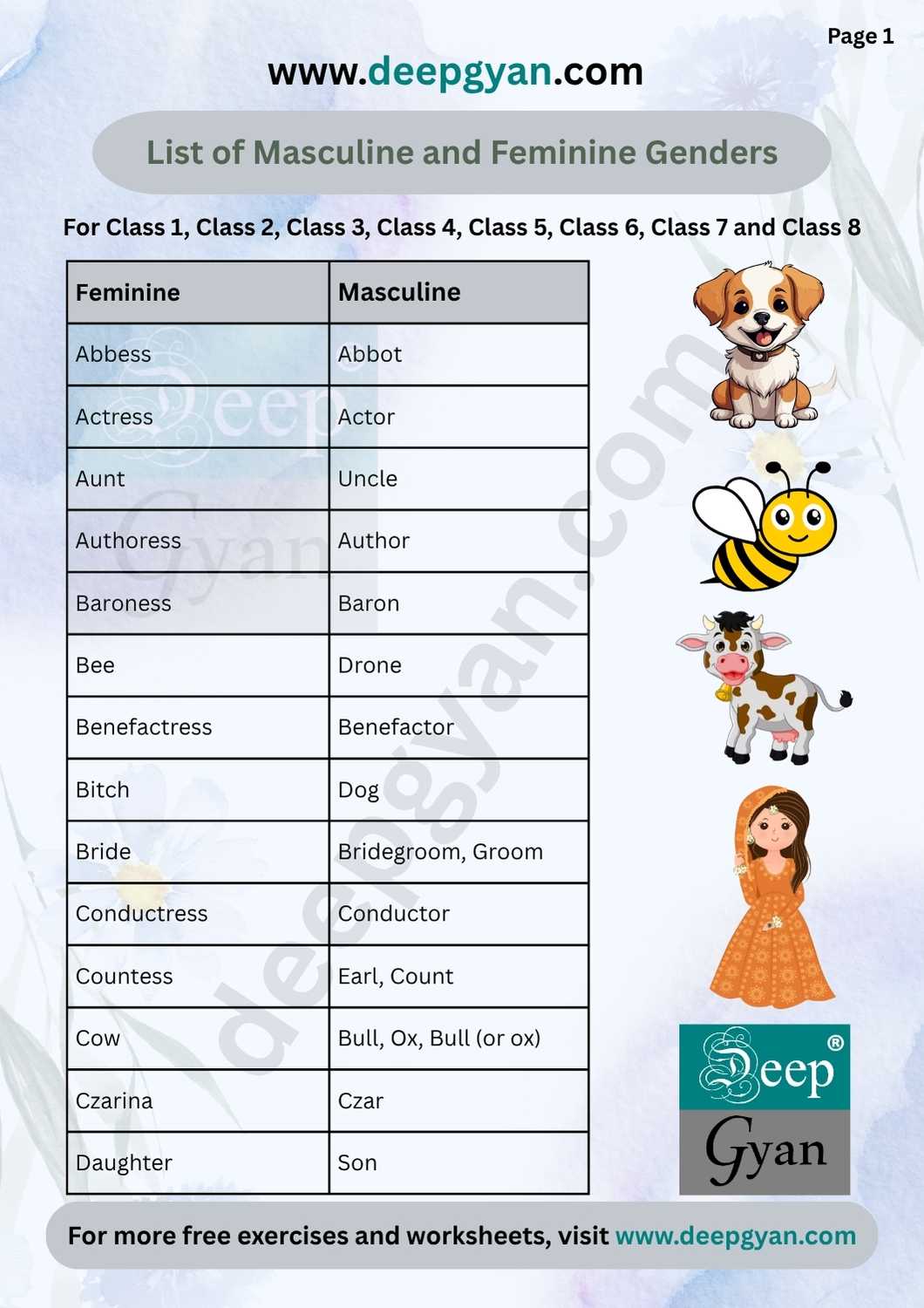
List of Masculine and Feminine gender
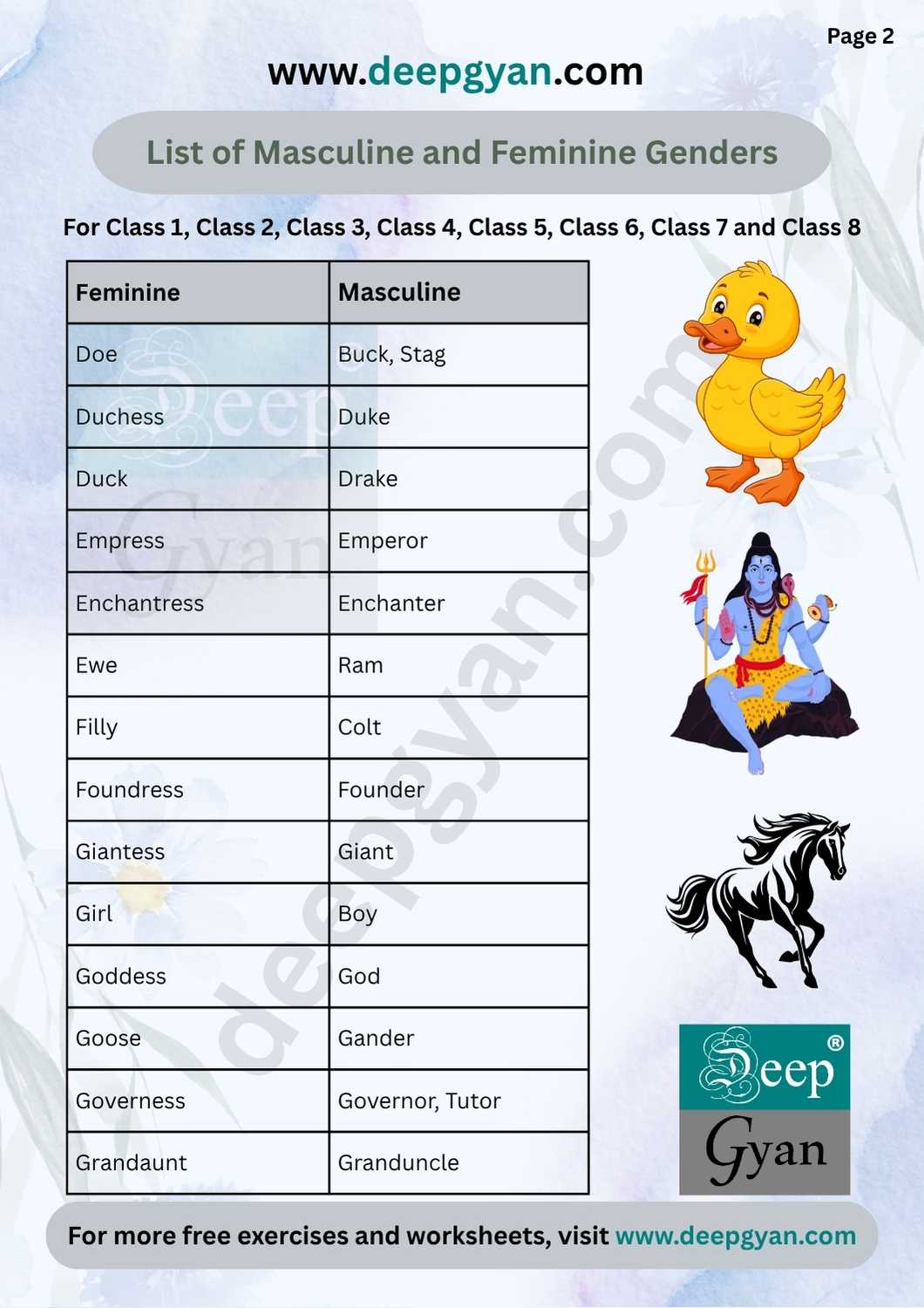
Masculine and Feminine Gender List
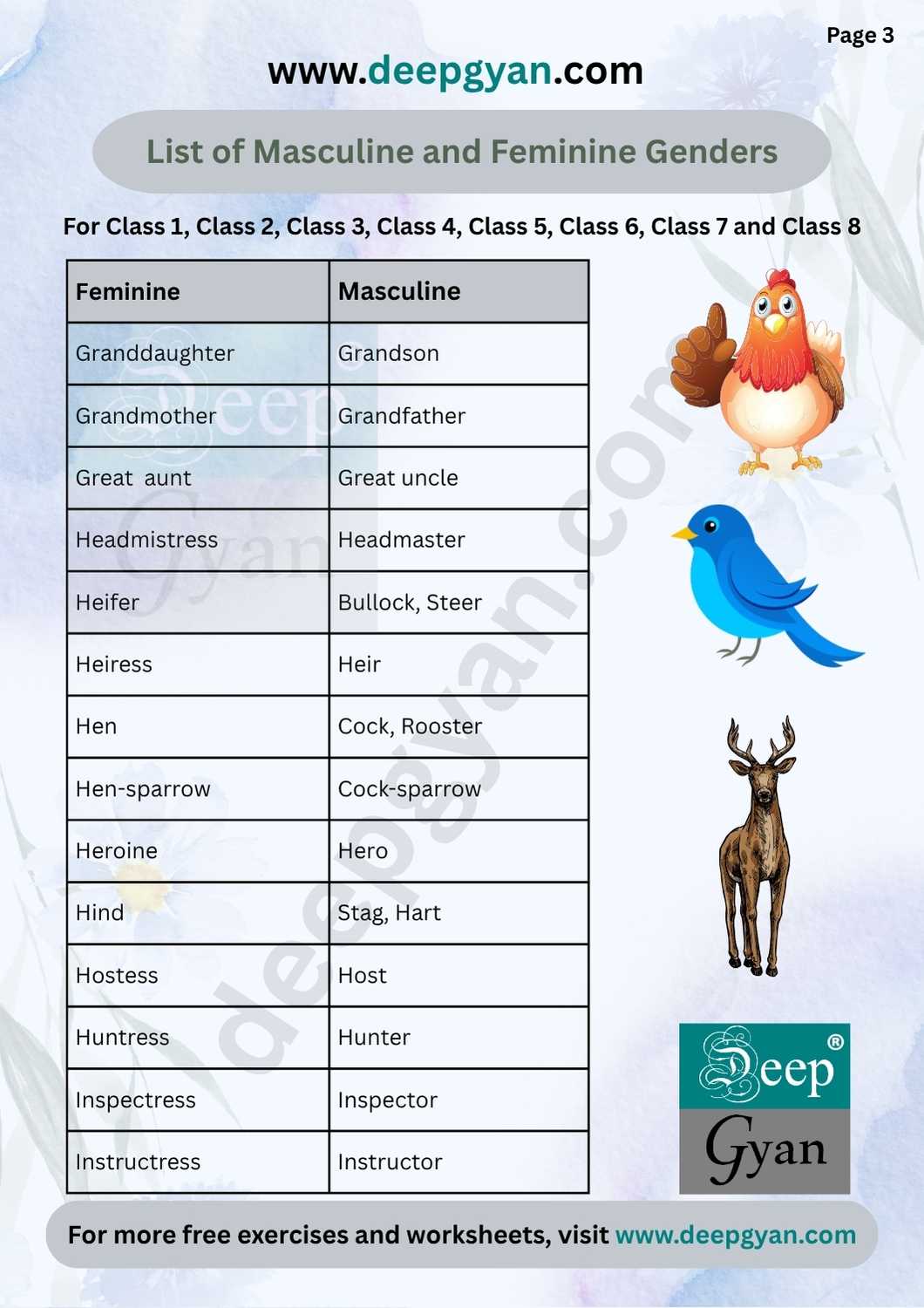
Feminine and Masculine Gender List
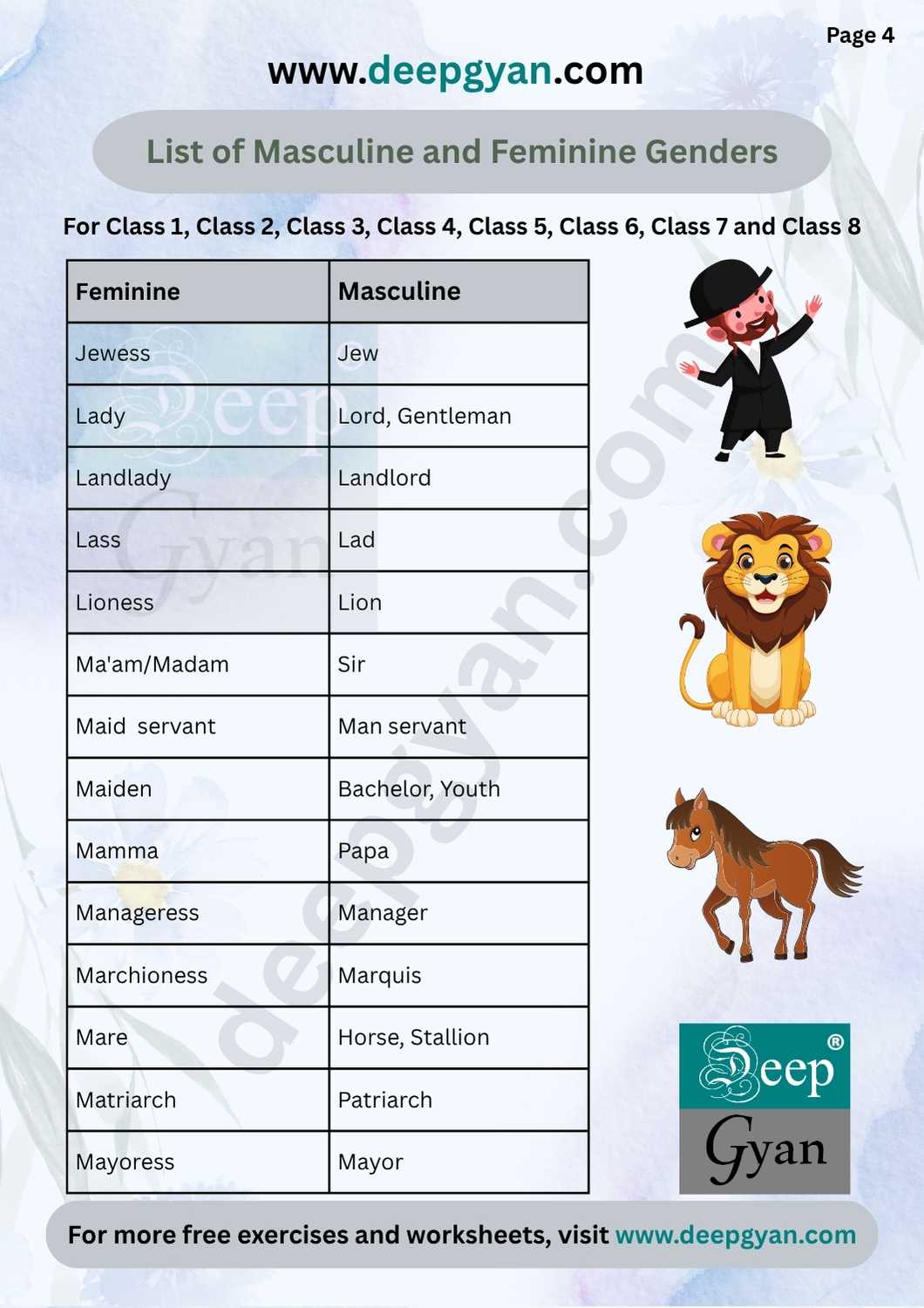
Feminine Masculine Gender List PDF
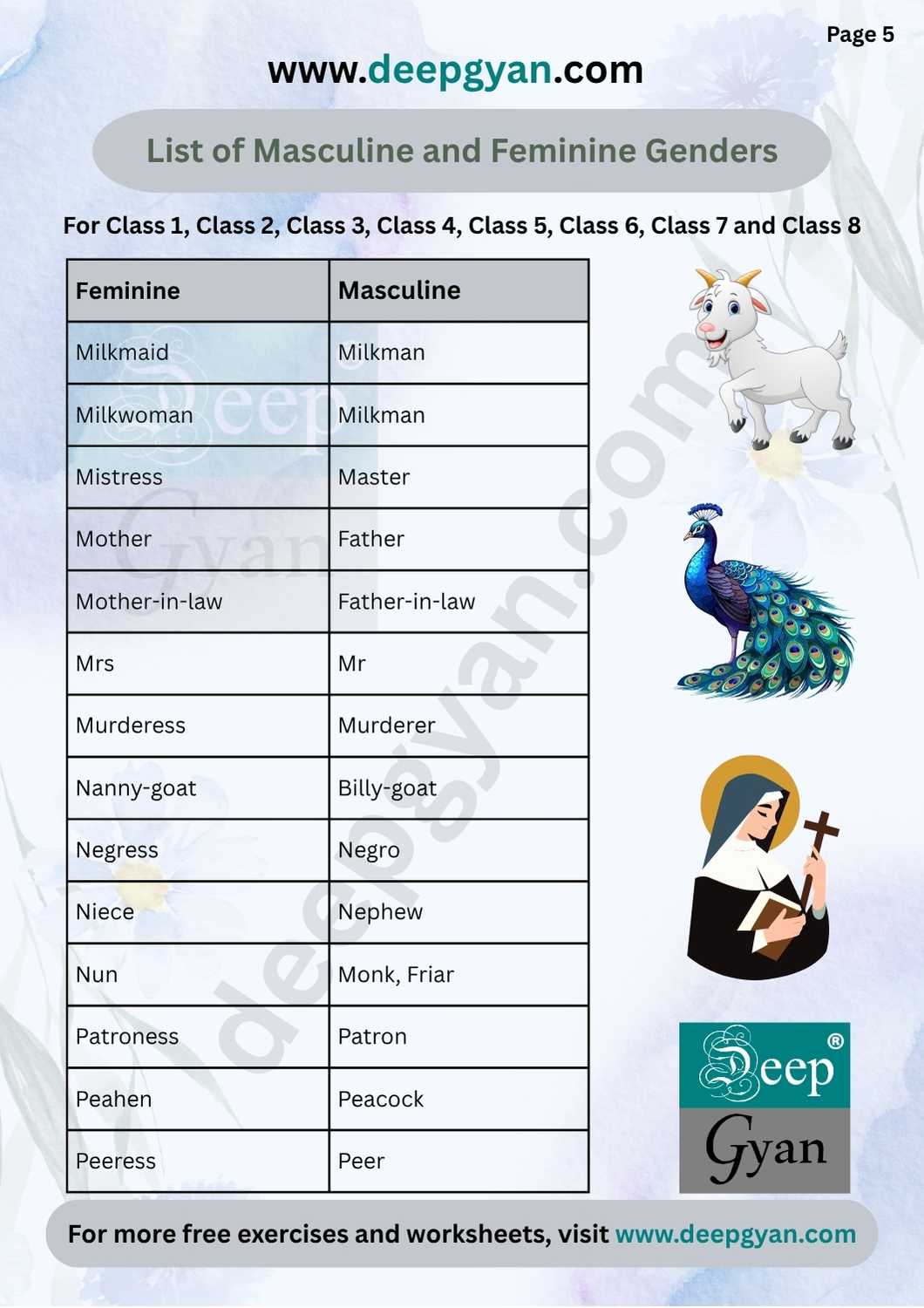
Masculine and Feminine Gender List with Pictures
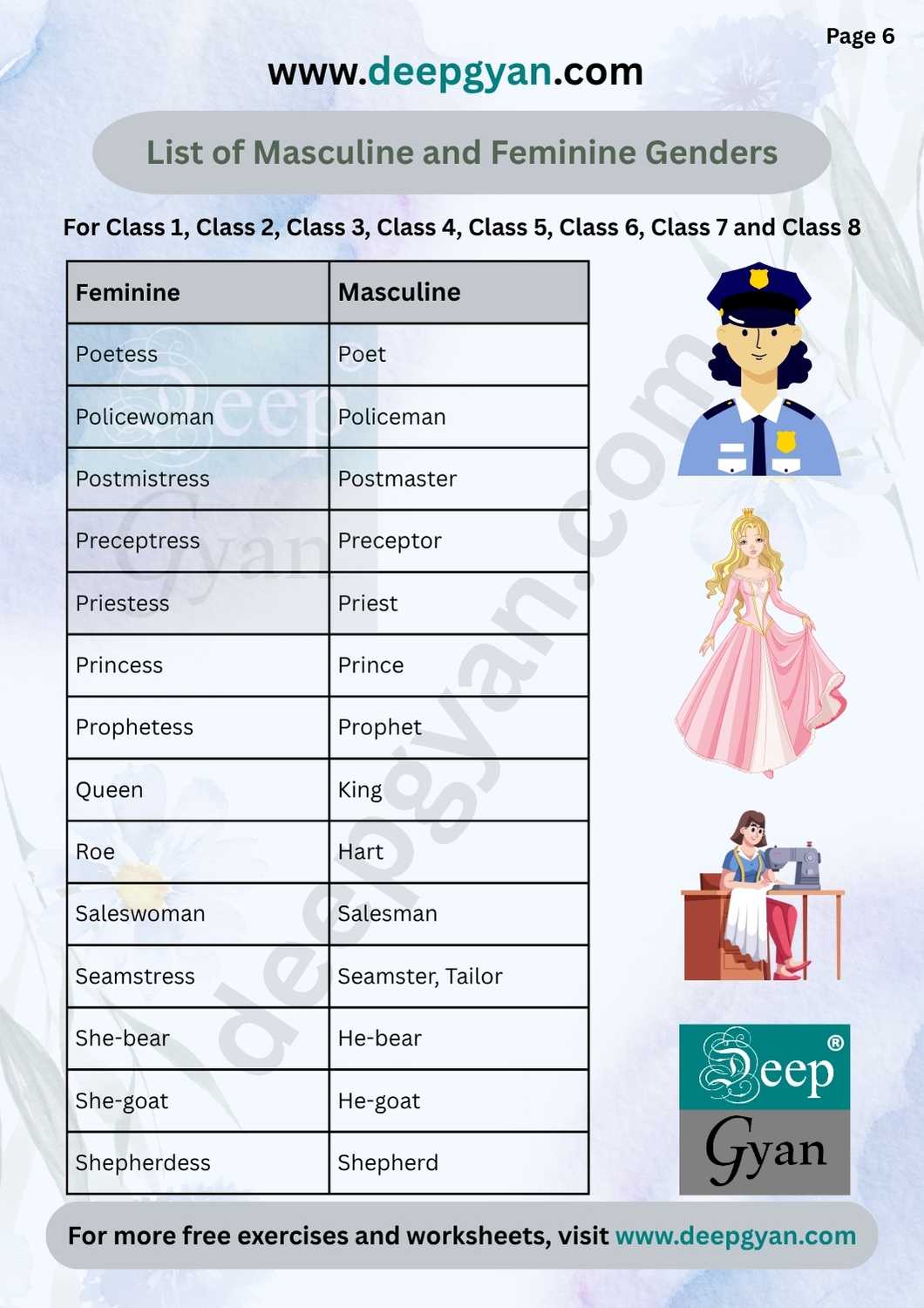
Masculine and Feminine Gender of Animals List PDF
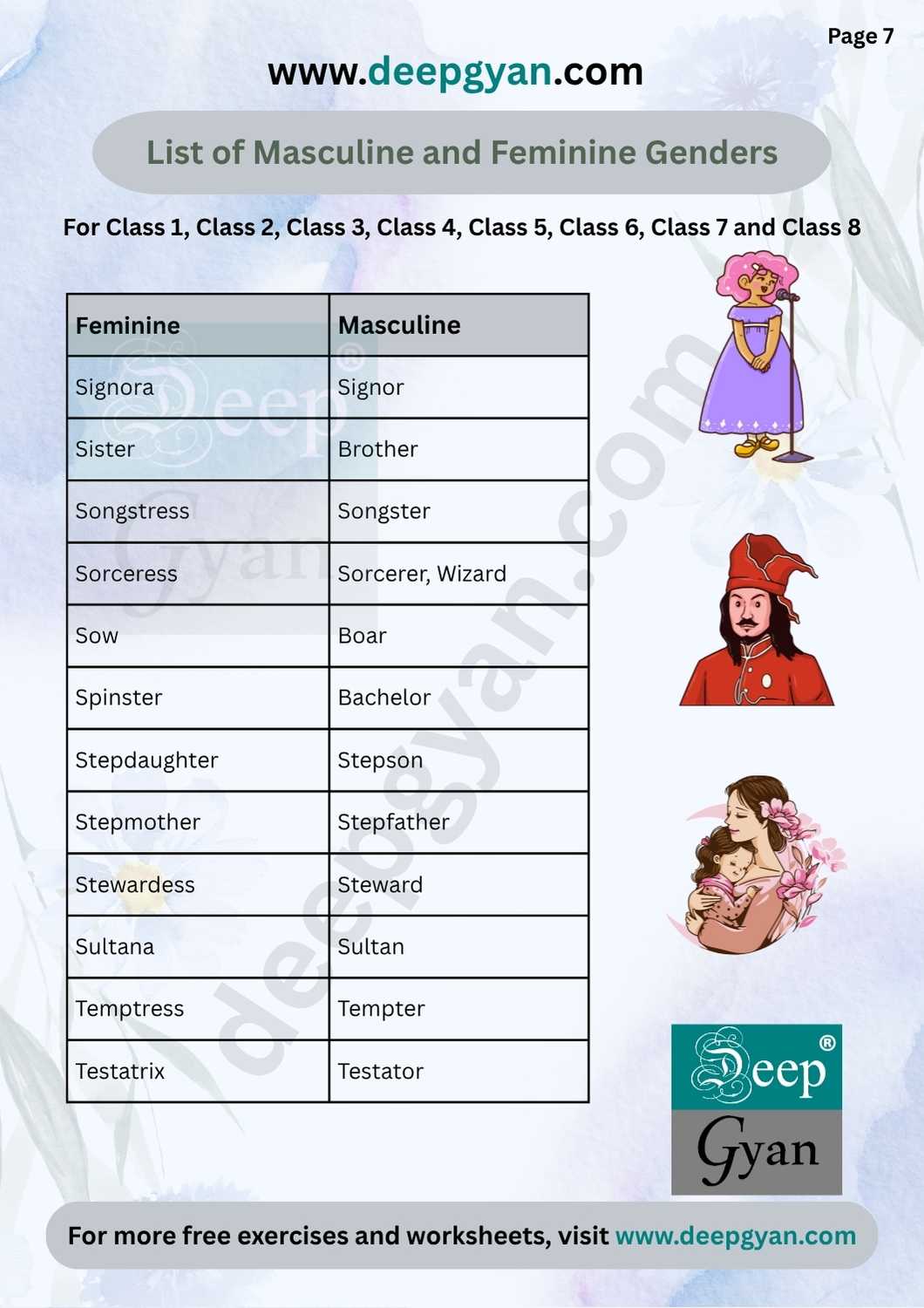
Masculine and Feminine Gender List A to Z
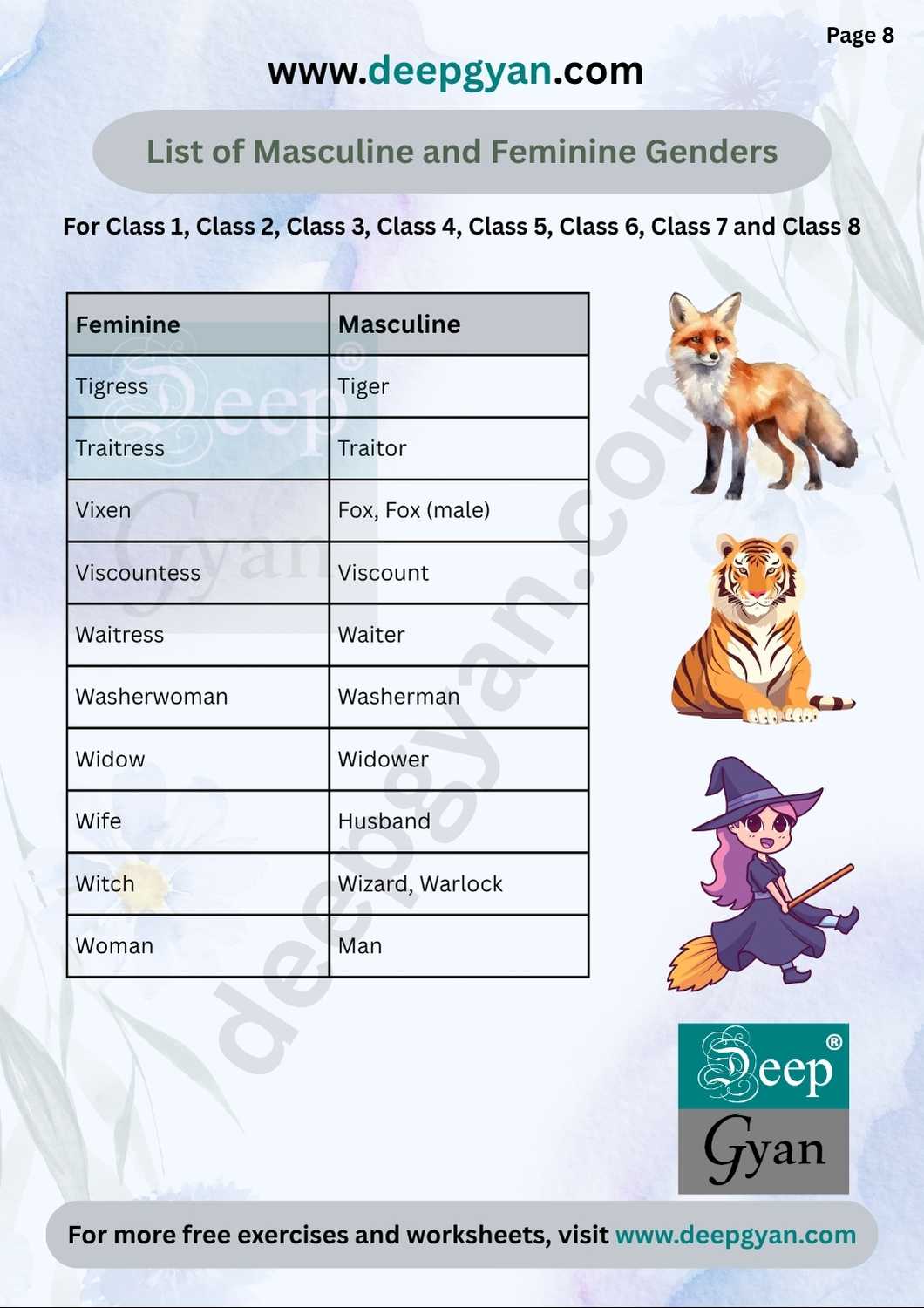
List of Masculine and Feminine Gender Words in English
Links of other related pages
Masculine and Feminine of Animals
Masculine and Feminine of Birds
Masculine and Feminine of Fish, Reptiles & Amphibians
100 Examples of Masculine and Feminine gender
Feminine of Nouns starting with 'A'
Feminine of Nouns starting with 'B'
Feminine of Nouns starting with 'C'
Feminine of Nouns starting with 'D'
Feminine of Nouns starting with 'E'
Feminine of Nouns starting with 'F'
Feminine of Nouns starting with 'G'
Feminine of Nouns starting with 'H'
Feminine of Nouns starting with 'I'
Feminine of Nouns starting with 'J'
Feminine of Nouns starting with 'K'
Feminine of Nouns starting with 'L'
Feminine of Nouns starting with 'M'
Feminine of Nouns starting with 'N'
Feminine of Nouns starting with 'O'
Feminine of Nouns starting with 'P'
Feminine of Nouns starting with 'Q'
Feminine of Nouns starting with 'R'
Feminine of Nouns starting with 'S'
Feminine of Nouns starting with 'T'
Feminine of Nouns starting with 'U'
Feminine of Nouns starting with 'V'
Feminine of Nouns starting with 'W'
Feminine of Nouns starting with 'X, Y, Z'
Masculine of Nouns starting with 'A'
Masculine of Nouns starting with 'B'
Masculine of Nouns starting with 'C'
Masculine of Nouns starting with 'D'
Masculine of Nouns starting with 'E'
Masculine of Nouns starting with 'F'
Masculine of Nouns starting with 'G'
Masculine of Nouns starting with 'H'
Masculine of Nouns starting with 'I'
Masculine of Nouns starting with 'J & K'
Masculine of Nouns starting with 'L'
Masculine of Nouns starting with 'M'
Masculine of Nouns starting with 'N'
Masculine of Nouns starting with 'O'
Masculine of Nouns starting with 'P'
Masculine of Nouns starting with 'Q & R'
Masculine of Nouns starting with 'S'
Masculine of Nouns starting with 'T'
Masculine of Nouns starting with 'U & V'